
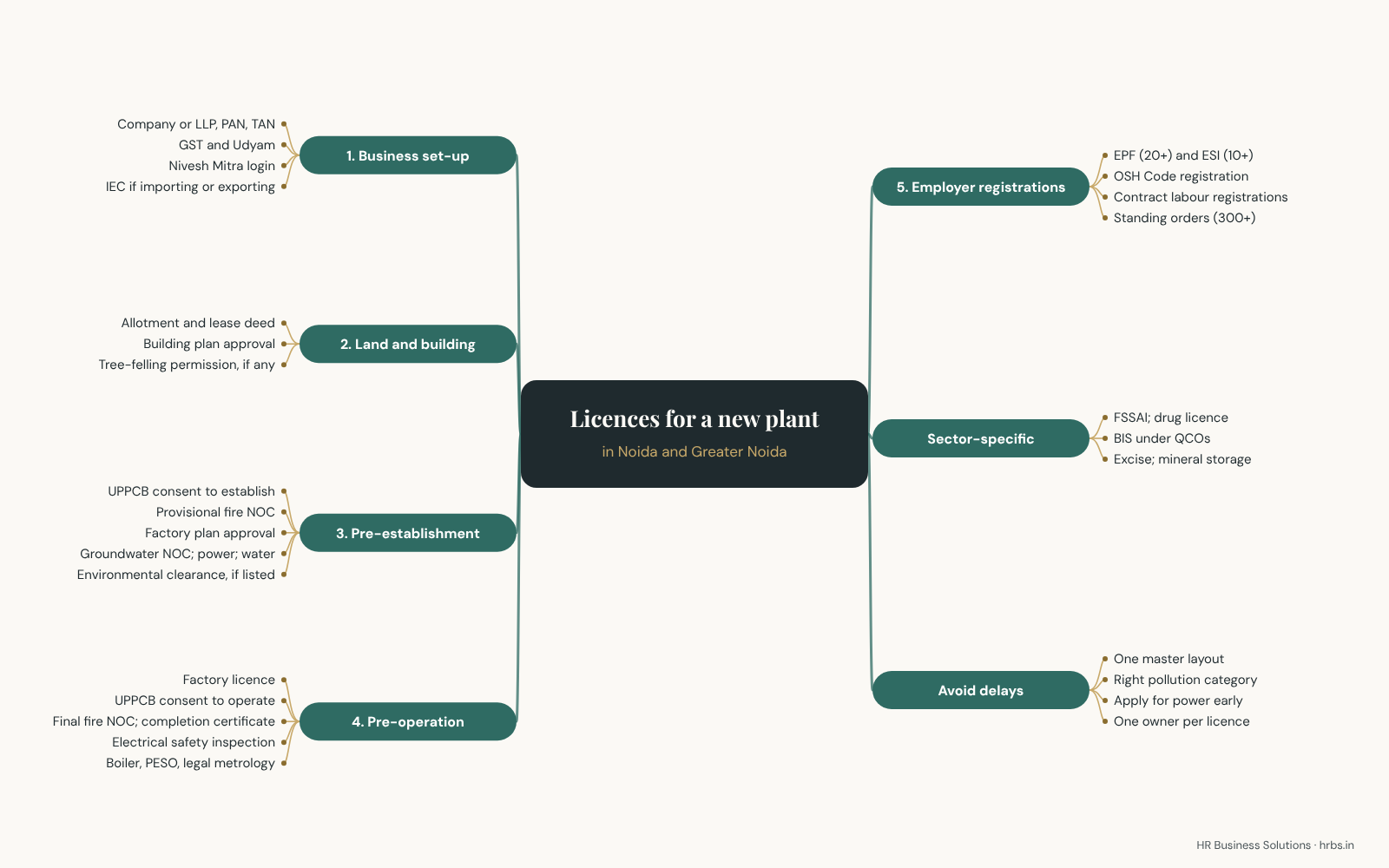
Setting up a new plant in Noida, Greater Noida or along the Yamuna Expressway requires an approval plan matched to your premises, manufacturing process and workforce. Depending on the project, that plan may involve the development authority, pollution control board, fire service, Labour Department, utilities and central agencies. Confirm the sequence before construction and commissioning to reduce avoidable rework.
This planning checklist helps MDs, CEOs, CFOs, CHROs, plant heads and project teams identify approvals to assess for a manufacturing unit in Gautam Buddha Nagar. It is not an exhaustive list or a finding that every approval applies to your plant. For help with labour registrations, contractor controls and ongoing records, explore our Statutory Compliance & Legal HR Service.
Key insights
- Most state approvals in Uttar Pradesh are applied for through Nivesh Mitra, the state's single-window portal, which separates pre-establishment and pre-operation clearances.
- Plan in five stages: set up the business, secure land and building approval, obtain pre-establishment clearances, obtain pre-operation licences, and plan employer registrations alongside workforce mobilisation, within each applicable statutory deadline.
- Which licences apply depends on your process, headcount, pollution category, fuel and chemical storage, water source and product. Build your own list from this one, not a generic checklist.
- Use the relevant Labour Code, Uttar Pradesh rules and current departmental filing instructions together. A portal retaining an older Act name does not establish which legal requirement applies.
Sources checked on 9 October 2026. This is general information to help you plan, not legal advice. Requirements depend on your industry, location and scale, and change over time. Confirm each approval on the official portal or with the issuing department before you rely on it.
1. How approvals flow for a new plant
Uttar Pradesh offers many state-level approvals through Nivesh Mitra. Its published checklist groups approval services into pre-establishment (before you build) and pre-operation (before you start production). Central registrations such as GST, EPF and ESI are made on their own portals.
| Stage | What it covers | Typical timing |
|---|---|---|
| 1. Business set-up | Entity, tax and MSME registrations | Early in project planning |
| 2. Land and building | Plot allotment, lease deed, building plan approval | Before construction |
| 3. Pre-establishment | Pollution consent to establish, fire NOC, factory plan approval, power, water | Before or during construction |
| 4. Pre-operation | Consent to operate, factory licence, final fire NOC, completion certificate, equipment approvals | Before the activity requiring approval, including trials where applicable |
| 5. Employer registrations | EPF, ESI, Labour Code registrations, contract labour | Plan before workforce mobilisation; meet the applicable filing deadlines |
2. Stage 1: Business set-up registrations
| Registration | Who needs it | Issued by | Apply at |
|---|---|---|---|
| Company or LLP incorporation (with PAN and TAN) | Any company or LLP | Ministry of Corporate Affairs | mca.gov.in |
| GST registration | Assess turnover, supplies and compulsory-registration provisions, including applicable exemptions | GST Network | gst.gov.in |
| Udyam registration | Micro, small and medium enterprises seeking MSME benefits | Ministry of MSME (free) | udyamregistration.gov.in |
| Investor registration on Nivesh Mitra | Anyone applying for UP state approvals | Invest UP | niveshmitra.up.gov.in |
| Importer-Exporter Code (IEC) | Importers and exporters covered by the IEC requirement, subject to DGFT exemptions | Directorate General of Foreign Trade | dgft.gov.in |
3. Stage 2: Land and building
For authority-allotted plots, check the relevant authority’s allotment and lease conditions. For purchased or leased private premises, verify title, permitted land use and the competent building authority. Noida Authority, Greater Noida Authority and YEIDA serve different jurisdictions.
| Approval | Notes | Issued by | Apply at |
|---|---|---|---|
| Land allotment and lease deed | Register the lease deed after allotment; keep allotment conditions and timelines for construction | Noida Authority, Greater Noida Authority or YEIDA | Noida Authority · Greater Noida Authority · YEIDA |
| Building plan approval | Needed before construction; the factory layout should match what you will submit for factory plan approval | Development authority | Authority portal or Nivesh Mitra |
| Tree-felling permission | Only if trees on the plot must be removed | Forest Department | Nivesh Mitra |
4. Stage 3: Pre-establishment clearances
| Clearance | Who needs it | Issued by | Apply at |
|---|---|---|---|
| Consent to Establish (CTE) under the Water and Air Acts | Industries that need pollution consent; the category (red, orange, green, white) decides the process | UP Pollution Control Board | uppcb.up.gov.in via Nivesh Mitra |
| Environmental clearance | Only projects listed under the EIA Notification, 2006 | Ministry of Environment or State authority | parivesh.nic.in |
| Fire NOC (provisional, before construction) | Buildings that fall under fire safety rules by height, area or occupancy | UP Fire and Emergency Services | Nivesh Mitra |
| Factory plan approval | Assess factory-plan approval before construction, extension or factory use under the applicable UP procedure | Labour Department (factories wing) | Nivesh Mitra; uplabour.gov.in |
| Groundwater NOC and registration | Industrial groundwater extraction: check NOC eligibility and well-registration requirements, including restrictions for the location | UP Ground Water Department | upgwdonline.in |
| Power connection and load sanction | Every plant; HT connections need more lead time | Relevant distribution licensee; confirm the service area for your plot | pvvnl.org · noidapower.com |
| Water and sewer connection | Plants using authority water supply or sewer | Development authority | Authority portal or Nivesh Mitra |
5. Stage 4: Pre-operation licences
| Licence | Who needs it | Issued by | Apply at |
|---|---|---|---|
| Factory licence or registration | The OSH Code’s general factory definition uses 20 workers with power or 40 without power. State-specific and hazardous-process provisions can affect coverage. Confirm the current UP licensing procedure; factory status and establishment registration are separate questions | Labour Department | Nivesh Mitra |
| Consent to Operate (CTO) | Units requiring operating consent under the applicable pollution-control rules; check current exemptions and consent conditions | UP Pollution Control Board | uppcb.up.gov.in via Nivesh Mitra |
| Hazardous waste authorisation | Activities covered by the Hazardous and Other Wastes Rules; assess your waste streams and handling role | UP Pollution Control Board | Nivesh Mitra / UPPCB current service |
| Waste-stream registrations and EPR | Covered roles under plastic, e-waste or battery rules, such as producers, importers, brand owners, recyclers or refurbishers, as defined for each stream | CPCB / relevant pollution control board, depending on the rules and role | CPCB EPR portals; Nivesh Mitra’s current services page directs these applications to CPCB portals |
| Final fire NOC | Buildings that obtained a provisional fire NOC | UP Fire and Emergency Services | Nivesh Mitra |
| Completion or occupancy certificate | As required under the applicable building regulations and sanctioned plan | Development authority | Authority portal or Nivesh Mitra |
| Electrical safety inspection | High-tension installations, transformers and DG sets as prescribed | Directorate of Electrical Safety | Nivesh Mitra |
| Boiler registration | Covered boilers: obtain registration, inspection and the required certificate before use under the Boilers Act, 2025, subject to exemptions | Boiler inspectorate | Nivesh Mitra |
| PESO licence | Covered petroleum, compressed-gas and explosives installations or activities; assess substance, quantity, use and exemptions under the relevant rules | Petroleum and Explosives Safety Organisation | peso.gov.in |
| Legal metrology licence or registration | Assess licences for manufacture, repair or sale of regulated instruments; packaged-commodity registration where required; verification of weighing and measuring instruments used in trade | Legal Metrology (Weights and Measures) | Nivesh Mitra |
6. Stage 5: Employer and labour registrations
HR, finance and project teams should assess these requirements before workforce mobilisation and assign responsibility for each filing. Follow the actual registration and contribution deadlines; the planning stages do not create a universal “before first payroll” legal deadline.
| Registration | Who needs it | Issued by | Apply at |
|---|---|---|---|
| EPF registration | General coverage trigger: 20 or more employees; assess scheme coverage, exemptions and employee eligibility | Employees' Provident Fund Organisation | epfo.gov.in |
| ESI registration | General trigger: 10 or more persons, other than seasonal factories. Notified hazardous occupations can be covered even with one employee. Confirm scheme implementation and individual eligibility | Employees' State Insurance Corporation | esic.gov.in |
| Establishment registration under the OSH Code | Assess Code establishment coverage and registration from 10 persons, including the Chapter II deeming provision for factories. Check notified hazardous activities and applicable UP rules; separately assess offices under UP shops legislation | Labour Department | Nivesh Mitra; uplabour.gov.in |
| Contract labour: establishment duties and contractor licensing | Contract-labour provisions generally cover establishments with 50 or more contract labour on any day in the preceding 12 months, and manpower-supply contractors meeting that threshold. Check contractor licensing and the plant’s establishment-registration duties separately | Labour Department | Nivesh Mitra; shramsuvidha.gov.in for central-sphere establishments |
| Standing orders: adoption / certification | Industrial establishments with 300 or more workers now or on any day in the preceding 12 months; assess model-order adoption or certification under the applicable procedure | Certifying officer, Labour Department | Labour Department |
| Apprenticeship registration | Plants engaging apprentices under NAPS or NATS | Apprenticeship authorities | See our NAPS, NATS and DBT guide |
These are Code-level planning triggers, not a substitute for the applicable Uttar Pradesh rules, notifications and departmental procedure. The Ministry’s employer handbook is explicitly for the Central Government sphere; its central filing procedure should not be applied automatically to a state-sphere plant. Our statutory compliance service helps organise the applicability review, owners and records.
7. Sector-specific licences
- Food processing: FSSAI licence or registration on FoSCoS.
- Drugs and cosmetics: manufacturing licence from the state Food Safety and Drug Administration, listed on Nivesh Mitra.
- Products under Quality Control Orders: Check the specific QCO, product scope, effective date, conformity scheme and exemptions on the BIS website.
- Distilleries, breweries and industrial alcohol: Excise Department licences, listed on Nivesh Mitra.
- Mineral storage: storage licence from the Geology and Mining Department where applicable.
8. Common causes of delay
- Layouts that don't match. The building plan, factory plan and fire layout are drawn separately and disagree. Freeze one master layout first.
- Wrong pollution category. Applying in the wrong category means rework. Confirm the category for your exact process first.
- Late power applications. HT connections and load sanctions take time; apply as soon as the load is known.
- Forgotten storage limits. Assess petroleum, gas and explosives rules for the exact substance and quantity. Not every chemical-storage activity is a PESO licensing matter.
- Labour registrations left to the end. Map employee and contractor headcounts early, then meet the applicable registration, contribution and licence deadlines.
- No owner per approval. Assign one named owner for each licence, with the renewal date in a shared compliance calendar.
Frequently asked questions
Can all these licences be applied for in one place?
Most Uttar Pradesh state approvals can be applied for and tracked through Nivesh Mitra. Central registrations such as company incorporation, GST, EPF, ESI, IEC, PESO and FSSAI use their own portals.
Does every new plant need a factory licence?
Not automatically. The OSH Code generally defines a factory at 20 workers with power or 40 without power, subject to state-specific and hazardous-process provisions. Establishment registration is a separate issue. Confirm coverage and the current UP licensing procedure for your premises.
What is the difference between consent to establish and consent to operate?
Where pollution consent is required, consent to establish covers the establishment stage and consent to operate covers operation. Check UPPCB’s current category, exemptions and consent conditions before construction, installation or production, including trials where applicable.
Do we need a groundwater NOC if we use authority water?
The NOC applies to extracting groundwater, such as through a borewell. If you rely only on authority supply, it may not apply, but confirm with the Ground Water Department before installing any borewell.
When should HR get involved in a new plant?
At the land and layout stage. Headcount and contract labour plans decide which labour licences apply, and the factory layout must meet welfare and safety requirements such as canteens, rest rooms and creches.
How HRBS can help
HRBS sets up the people side of new plants: labour licences and registrations, contract labour controls, standing orders, payroll and statutory registrations, and the compliance calendar, alongside your legal and project advisers. See our statutory compliance service or request a callback for a free new-plant compliance review.
Official websites
- Nivesh Mitra, Uttar Pradesh single-window portal and its checklist of approvals.
- Invest UP: Nivesh Mitra single-window clearance.
- Noida Authority, Greater Noida Authority and Yamuna Expressway Industrial Development Authority.
- Uttar Pradesh Pollution Control Board.
- Labour Department, Uttar Pradesh.
- UP Ground Water Department.
- Paschimanchal Vidyut Vitran Nigam (PVVNL) and Noida Power Company (NPCL).
- PARIVESH (environmental clearances).
- Petroleum and Explosives Safety Organisation.
- Ministry of Corporate Affairs, GST portal, Udyam registration and DGFT.
- EPFO, ESIC and Shram Suvidha.
- FSSAI FoSCoS.
- Ministry of Labour: OSH Code FAQs and OSH Code text: definitions and contract-labour provisions.
- Ministry of Labour: employer handbook (Central Government sphere), including Social Security Code First Schedule and standing orders.
- Boilers Act, 2025 — official Act text.
- Nivesh Mitra current services and CPCB waste-portal routing. The portal advises using version 2.0 for services not available in version 3.0.
How exposed is your organisation? Take the free HR Self-Assessment: 50 short statements, about 10 minutes, with your top people-management risks and the fix for each.