
Many organisations do not lack performance processes; they lack consistent management habits. A policy may say “recognise good work”, yet employees experience recognition only when a deadline is rescued, a customer complains or an annual award is due.
The practical challenge is to make high-quality recognition part of normal management work: prompted by clear cues, delivered specifically and fairly, and supported by simple systems. Done well, recognition reinforces the behaviours and outcomes the organisation needs. It does not replace fair pay, safe work, adequate staffing or capable leadership.
Key insights
- Recognition works best when it is timely, specific, credible and linked to a meaningful contribution.
- Gallup reported that only one in three US workers strongly agreed they had received recognition or praise for good work in the previous seven days.
- A later Gallup–Workhuman study found that well-recognised employees were 45% less likely to have changed organisations two years later. This is an association, not proof that recognition alone caused retention.
The habit loop, applied carefully to management
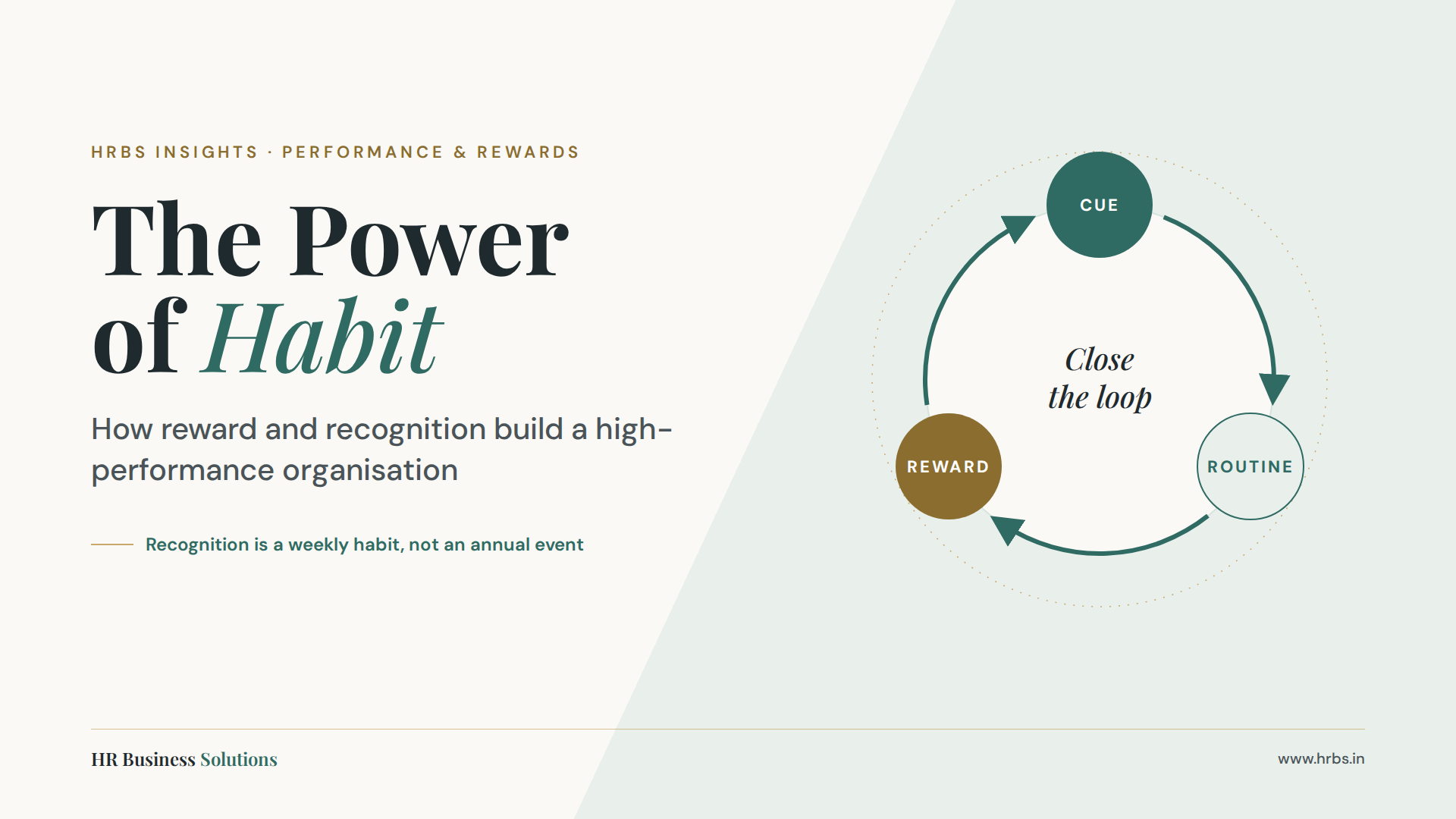
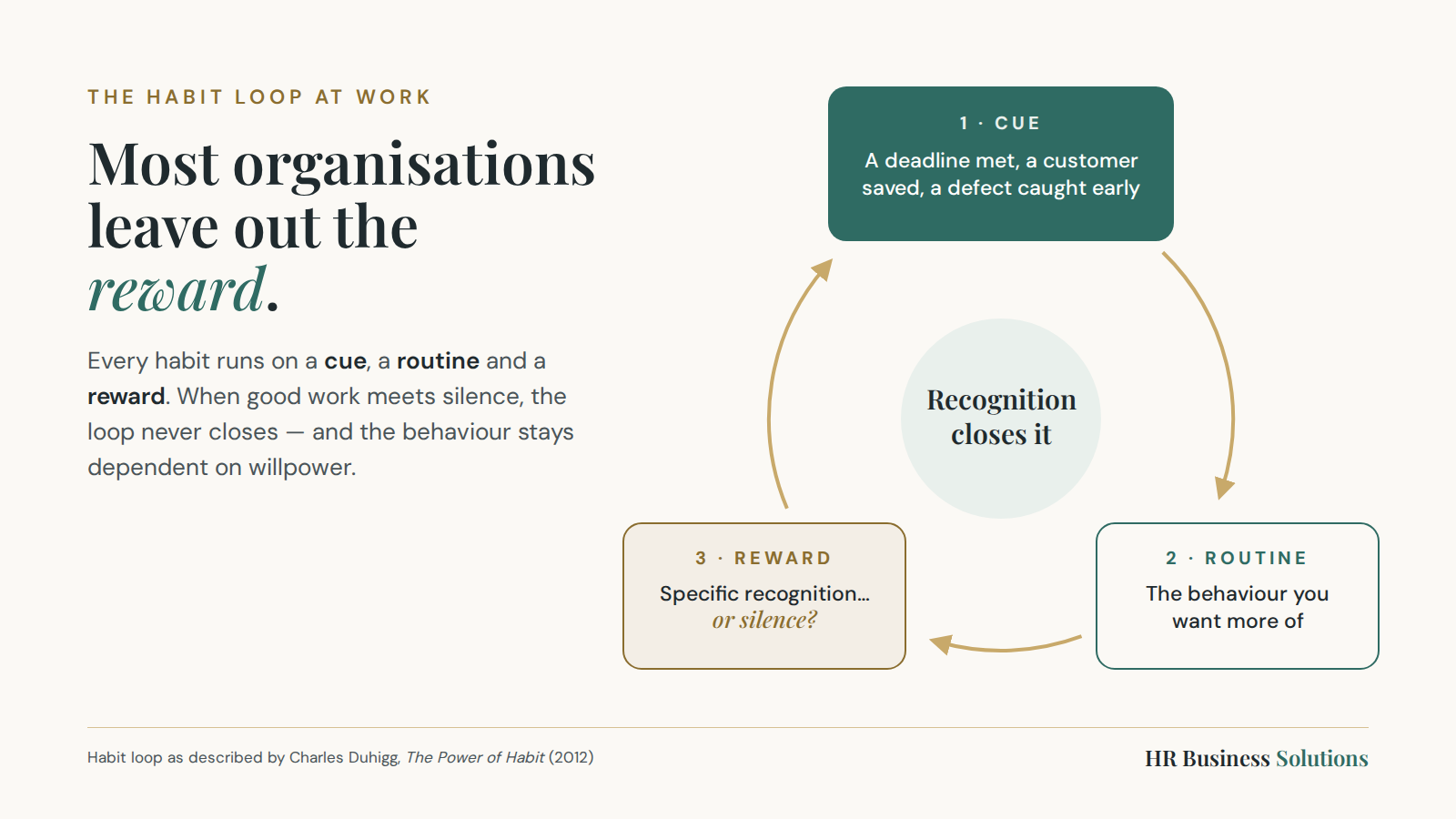
Popular habit models describe a loop of cue, routine and reward. Applied to recognition, the cue might be a weekly team review, a customer compliment or completion of a meaningful milestone. The routine is a manager noticing the contribution and giving specific feedback. The reward is the employee understanding that the contribution mattered—and, where appropriate, receiving a valued form of acknowledgement.
This is a useful design analogy, not a scientific claim that every workplace behaviour follows one universal loop. The quality of the message, the employee’s preference and the fairness of the system matter more than mechanically “closing a loop”.
What the evidence says—and what it does not
Gallup’s workplace research highlights a large recognition gap. In one report, only one in three US employees strongly agreed they had received recognition or praise for doing good work in the previous seven days. Employees who felt inadequately recognised were twice as likely to say they would quit in the next year.
Gallup and Workhuman later followed nearly 3,500 employees between 2022 and 2024. Employees who had received high-quality recognition were 45% less likely to have changed organisations two years later. That is a meaningful relationship, but leaders should not read it as a guaranteed retention effect or transplant a US estimate directly into India. Establish a local baseline, track patterns over time and consider other influences such as pay, manager quality, career opportunity, workload and labour-market conditions.
Can recognition become a keystone habit?
Charles Duhigg uses the term “keystone habit” for a routine that can trigger wider changes. Recognition can play that role as a management analogy: noticing good work forces leaders to clarify what “good” means, pay attention to behaviour and outcomes, and give timely feedback. Those routines can improve goal clarity and trust.
But recognition is not a cure-all. Praise cannot compensate for inequitable pay, unsafe conditions, chronic overwork, unclear roles or poor job design. If those foundations are weak, an employee-recognition campaign may feel performative rather than motivating.
An eight-step HRBS framework
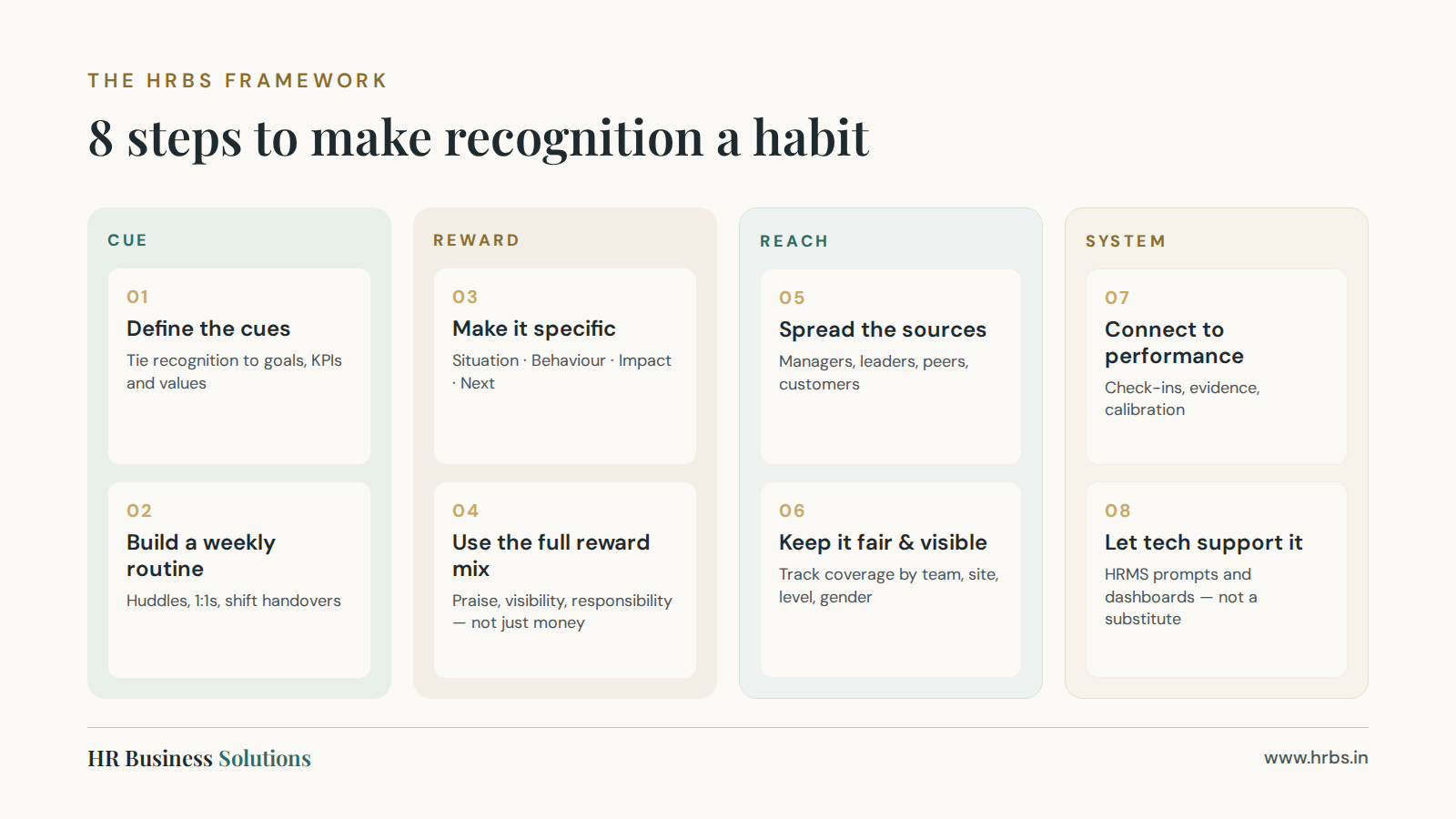
1. Define the cues
Choose moments that deserve attention: a customer success, a safe and efficient improvement, knowledge sharing, a difficult problem solved, a quality milestone or progress against a team goal. Do not recognise visible busyness while overlooking quieter, high-value work.
2. Build a weekly noticing routine
Add a short prompt to an existing meeting or manager checklist: “Who contributed meaningfully this week, and what was the impact?” Gallup’s seven-day wording is a useful reminder, not a quota requiring every person to be praised on an identical schedule.
3. Make recognition specific
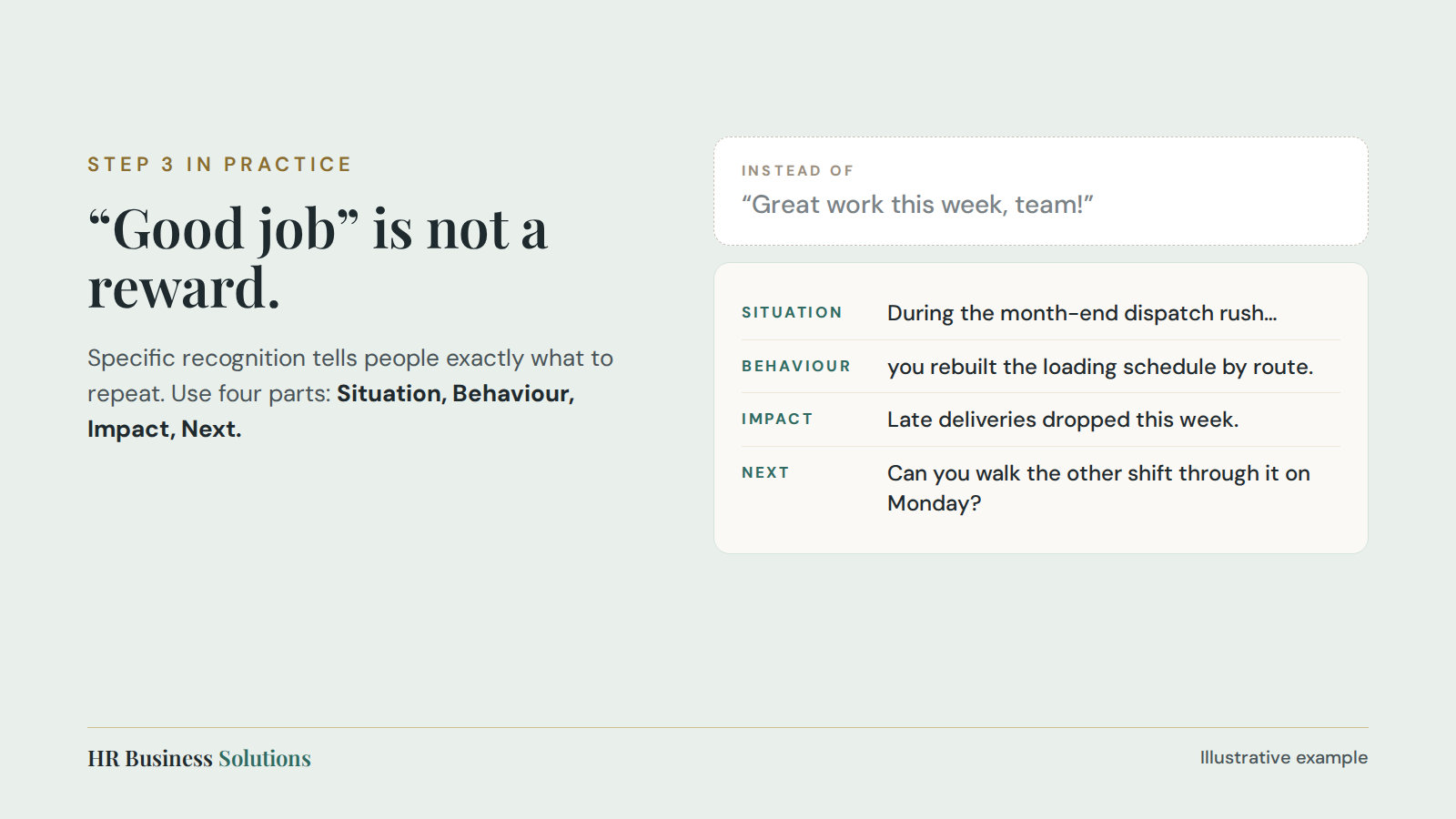
Use the HRBS SBI-N prompt—an adaptation of situation–behaviour–impact feedback: name the situation, the observable behaviour, its impact, and the next behaviour worth sustaining.
“During Monday’s client escalation, you brought operations and payroll together, checked the source data and gave the client a clear recovery plan. That protected the relationship and helped us close the issue the same day. Please keep using that cross-team approach.”
4. Personalise the reward mix
Ask how each employee prefers to be recognised. Options may include private thanks, public acknowledgement, learning opportunities, expanded responsibility, time flexibility, a spot award or a team celebration. A public announcement can motivate one person and embarrass another.
5. Widen the sources
Enable appreciation from managers, peers, customers, project leads and senior leaders. Multiple sources reduce dependence on one manager’s line of sight—but every recognition should still be checked against clear, job-relevant standards.
6. Audit fairness and visibility
Review who is recognised, for what, by whom and in which locations or work patterns. Look for remote staff, support functions, shifts or demographic groups being overlooked. Use lawful, proportionate analysis; report small groups only in aggregated form and restrict access to personal data.
7. Connect recognition to performance management
Capture credible examples during regular check-ins so the year-end discussion is not distorted by recent events. Recognition should support coaching and goal conversations—not become an unmoderated points contest. See our performance management tips for managers and Talent Management & Workforce Productivity service.
8. Use HR technology as support
An HRMS can send prompts, record examples and show coverage patterns. Keep the workflow short enough that managers will use it. Technology should support genuine human acknowledgement, not replace it.
Guardrails leaders should set
- Reward the right outcomes. Never celebrate overwork, presenteeism, hidden quality failures or unsafe shortcuts.
- Use transparent criteria. Explain what contributions merit recognition and apply the standard consistently across comparable roles.
- Respect preference. Offer private and public options; never require an employee to participate in a public ceremony.
- Protect privacy. Limit personal data, define access and retention, and use minimum reporting thresholds for group comparisons.
- Keep recognition in perspective. It complements—not substitutes for—fair pay, reasonable workload, development, employee voice and safe working conditions.
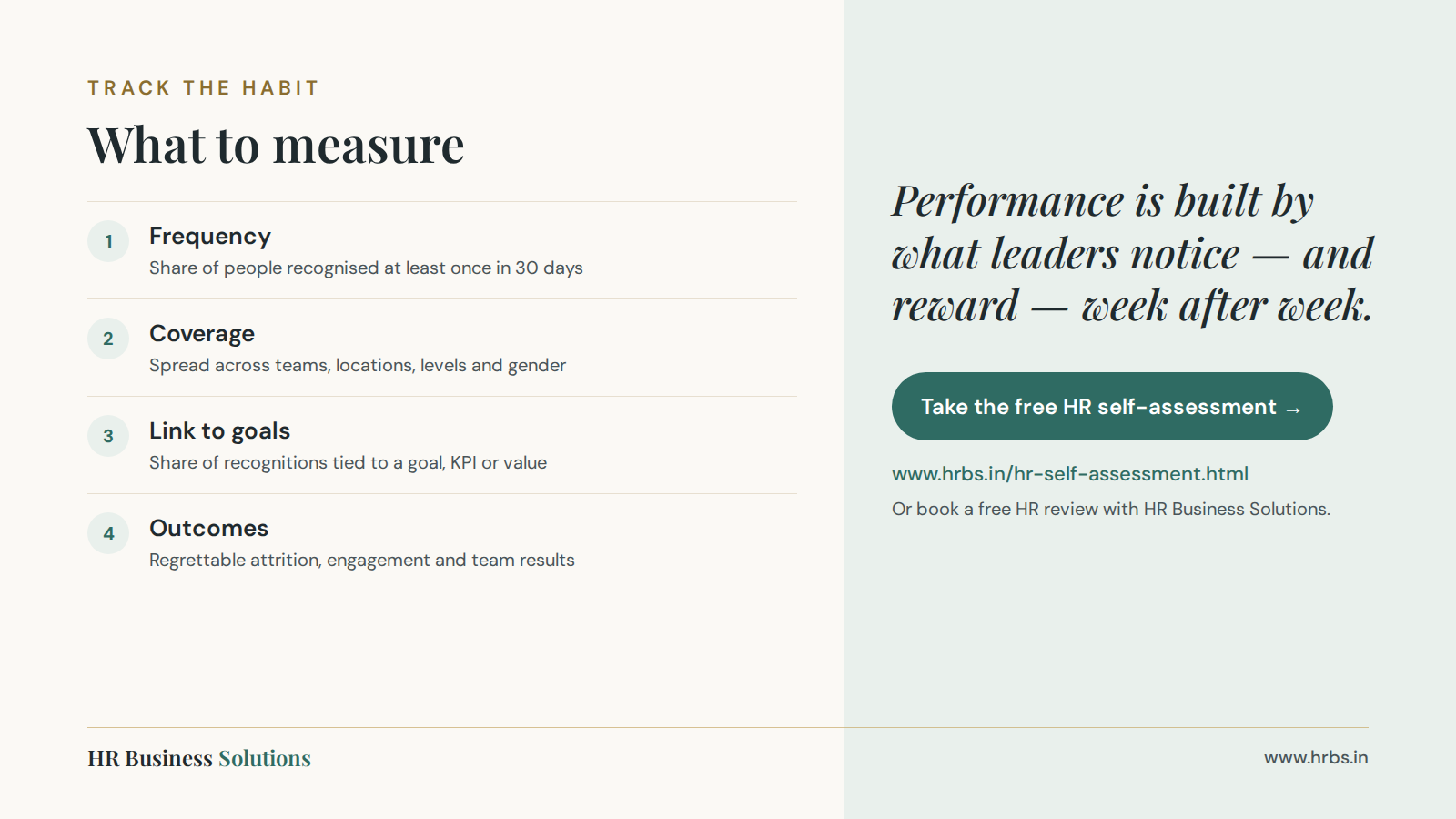
What to measure
Measure enough to improve the system without turning appreciation into a mechanical compliance exercise.
- Frequency: meaningful recognition moments per employee or team over a defined period.
- Coverage: the percentage of eligible employees recognised, reviewed by function, level, location and work pattern where lawful and statistically sensible.
- Quality: a short employee pulse on whether recognition felt timely, specific, fair and personally meaningful.
- Alignment: the percentage of examples linked to a stated goal, value, customer outcome, safety or quality standard.
- Outcomes: trends in regrettable turnover, absence, engagement, quality or customer measures. Treat movement as a signal for investigation, not automatic proof of causality.
The bottom line
Recognition becomes useful when it is more than an award programme. Give managers clear cues, a simple routine, practical language, fair standards and evidence they can learn from. Then keep the human judgement that makes the message credible.
HRBS can help you diagnose recognition gaps, design a fair framework, build manager capability and configure the workflow in your HR system. Book a free HR review to discuss the next practical step.
Sources and further reading
- Gallup: Employee Recognition—Low Cost, High Impact.
- Gallup and Workhuman: Employee Retention Depends on Getting Recognition Right.
- NPR interview with Charles Duhigg on habits; Duhigg, C. (2012), The Power of Habit.
An earlier version of this article was also published by HRBS founder Rajeev Kumar on LinkedIn. This HRBS edition has been updated for evidence precision and practical implementation.