In Indian hiring, "offer accepted" is not the finish line. Between a signed offer and the first day, notice periods, counter-offers, competing opportunities and unanswered questions can change a candidate’s decision. A no-show may restart the search and delay the work the person was hired to deliver.
Pay matters alongside role clarity, employer credibility, the hiring experience and contact after an offer. This playbook gives MDs, CEOs, CFOs, CHROs and hiring managers practical controls to assess and improve. It connects employer branding with our Global Talent Acquisition & Employer Branding service.
Key insights
- Make your employer promise concrete. Randstad’s 2026 India research identifies work-life balance and equal opportunities as the leading attributes of an ideal employer. Explain the actual work pattern, growth opportunities and management practices behind your promise.
- Build trust in how you assess candidates. Current recruiting research highlights skills verification and human engagement as AI reshapes hiring. Keep assessments relevant and explain where technology and people take part.
- The notice period needs an owner and a useful contact plan. Agree the cadence with the candidate and resolve questions before joining day.
- Measure offer-to-join ratio and 90-day attrition, not just time to fill.
What current research says in 2026
Sources checked on 9 October 2026. Survey populations and markets differ; these findings do not measure your organisation’s offer-to-join performance.
1. Work-life balance and fairness belong in the employer promise
Randstad Employer Brand Research 2026 — India, drawing on nearly 3,500 working-age professionals, identifies good work-life balance (60%) and equal opportunities (59%) as the two leading attributes of an ideal employer. It also reports that 46% intend to change jobs in the next six months, compared with 32% who moved in the preceding six months. These are employer preferences and mobility intentions, not offer-drop-off rates.
HRBS recommendation: show the actual hours, work location, flexibility available for the role, progression criteria and manager support. For shopfloor roles, explain shifts, overtime arrangements, transport and leave clearly. Promise only what the team can deliver.
2. Verify relevant skills and keep a human relationship
LinkedIn’s 2026 Future of Talent report describes a broader talent function connecting hiring, development and internal mobility to business outcomes. It also highlights trusted skill signals and sustained human engagement alongside AI. This is international research, not an India-specific estimate of joining behaviour.
HRBS recommendation: use a short, job-relevant work sample and structured interview criteria, explain what good performance looks like, and keep the hiring manager involved. At intake, assess whether an internal move or development could meet the need before opening an external search.
3. Explain AI use throughout the hiring process
In a 17 June 2026 opinion article published by Indeed, talent strategy adviser Kyle M.K. argues for clear explanations of how AI is used, where humans remain involved and how candidates can raise questions. Treat this as expert guidance, not a measured India-wide result.
HRBS recommendation: give candidates a plain-language process summary, tell them what AI assistance is allowed in assessments, provide a human contact, and review screening decisions for consistency. Automate reminders and administration while retaining accountable human judgement.
4. Connect recruitment with the experience after joining
HRBS recommendation: combine joining conversion with 30-, 60- and 90-day check-ins, role outcomes and candidate feedback. Compare completed cohorts by role and source so faster hiring does not hide poor role fit or an employer promise that onboarding fails to deliver.
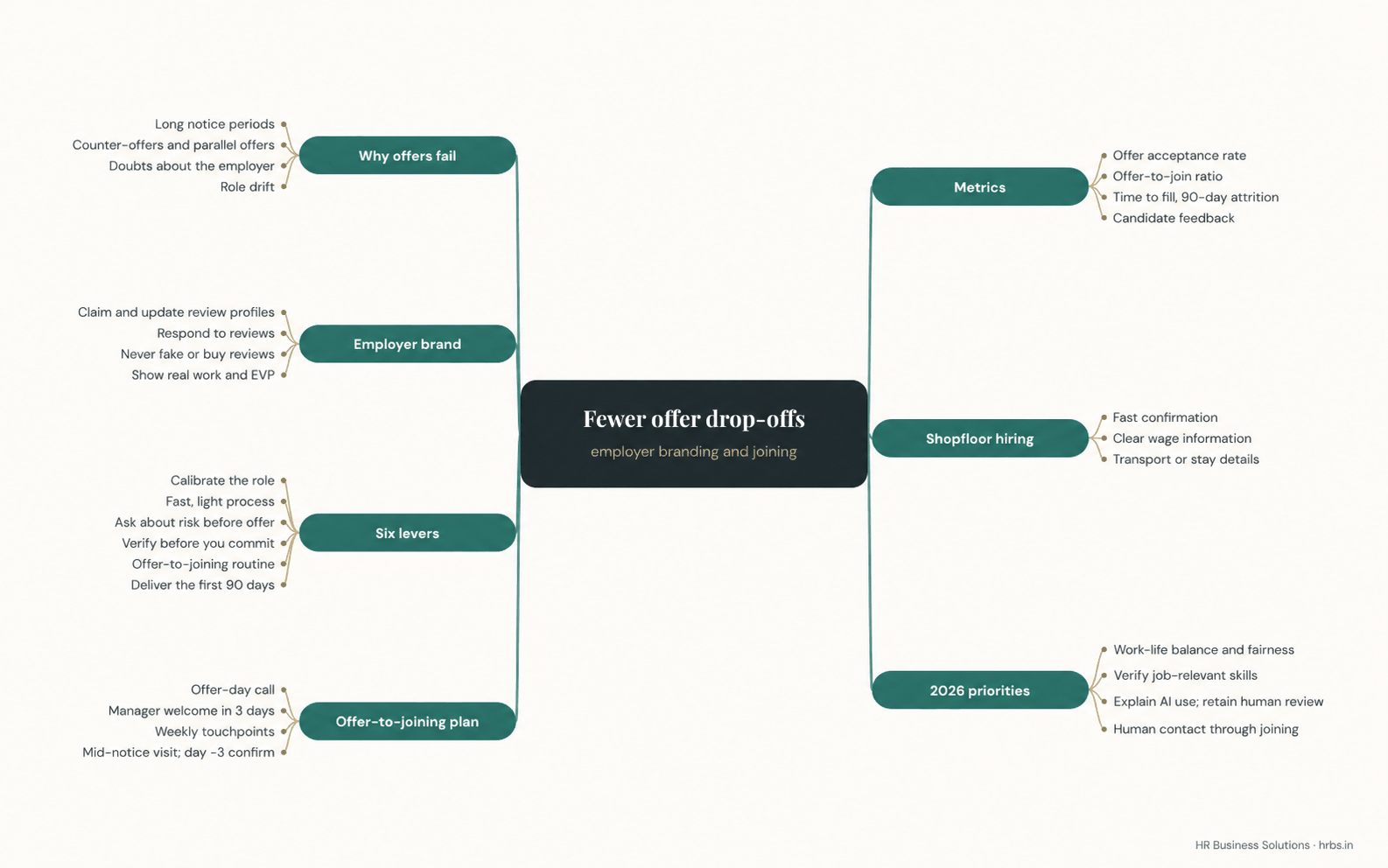
1. Why accepted offers fail
- Long notice periods. Extended notice periods leave more time for circumstances and competing opportunities to change.
- Counter-offers. A raise or promotion from the current employer can change the decision. Discuss the possibility before extending the offer.
- Parallel offers. Candidates may continue considering opportunities after accepting. Keep your role and joining plan clear while respecting their choice.
- Doubts about the employer. A poor rating, unanswered negative reviews, or a vague role description invites second thoughts.
- A role that drifted. If the job described in the final round differs from the job in the advert, trust drops.
2. Employer brand starts before the job description
Employer branding is what a candidate can find and trust about working for you. Connect your careers content, employee feedback and hiring conversations to the real employee experience. The current research above supports making work-life balance, fairness, skills and transparency visible; the actions below put that into practice.
Practical steps:
- Claim and maintain your profiles on AmbitionBox, Glassdoor, LinkedIn and Google. Keep facts current: locations, size, benefits, shifts.
- Respond to reviews, especially critical ones, calmly and specifically. Say what you have changed.
- Never post or buy fake reviews, and never pressure employees or offer incentives for reviews. Glassdoor’s Community Guidelines permit inviting honest feedback but prohibit incentives. Respond without revealing personal employee information.
- Show real work: photos of the actual workplace, a day in the role, who the person will report to, and how performance is judged.
- Publish an honest employer value proposition: a clear explanation of pay and benefits, development, work arrangements and management support, backed by real employee feedback and approved workplace examples.
3. Six levers that reduce drop-offs
Lever 1: Calibrate the role before sourcing
Agree with the hiring manager on the outcomes the role must deliver in its first year, the four or five must-have skills, the salary band and the deal-breakers. Write it down as a one-page scorecard. Many late-stage rejections and drop-offs trace back to a role that was never clearly agreed.
Lever 2: Make the process fast and light
Set a target, such as decision within 10 working days of the first interview. Combine rounds where you can, give feedback within 48 hours, and share the full process and timeline at the first conversation.
Lever 3: Ask about risk before the offer
Ask directly: "Are you in other processes? If your current employer counter-offers, what would you do? What would make you stay there?" The answers tell you whether to move faster, adjust the offer or prepare for a counter-offer conversation.
Lever 4: Verify before you commit
Explain relevant checks early and obtain the candidate’s permission before contacting referees or a current employer. Use proportionate employment and skills checks at the agreed stage, and allow candidates to clarify discrepancies. Make any outstanding offer conditions explicit.
Lever 5: Run a planned offer-to-joining routine
Assign one owner, usually the recruiter, and a second contact, the hiring manager. Use the sequence below.
Lever 6: Deliver on the first 90 days
An early exit is a drop-off that happens after joining. Have the laptop, ID, workspace and first-week plan ready on day one, and hold check-ins at 30, 60 and 90 days. If many exits happen within the first year, the cause may be inside the organisation; our workforce productivity and culture engineering services look at that side.
4. An offer-to-joining sequence
This is a suggested operating cadence. Adapt it to the candidate’s notice period and preferences; pre-joining contact should be voluntary and should not require unpaid productive work.
| When | Action | Owner |
|---|---|---|
| Offer day | Call to walk through the offer, then send it in writing the same day. Confirm resignation timing. | Recruiter |
| Within 3 days | Welcome message from the hiring manager. Share the team, the first projects and the onboarding plan. | Hiring manager |
| After resignation | Confirm the resignation was accepted and the last working day. Discuss any counter-offer openly. | Recruiter |
| Every week of the notice period | A short, useful touchpoint: an optional introduction, a practical joining update, or a question answered. | Recruiter and manager, alternating |
| Mid-notice | Invite the candidate to visit, meet the team or join a team lunch, if practical. | Hiring manager |
| Two weeks before joining | Collect documents, prepare IT, payroll and access for activation on joining, and share the day-one agenda. | HR operations |
| Three days before joining | Confirm arrival time, reporting place and who will meet them. | Recruiter |
5. Metrics to track
| Metric | How to calculate it | What it tells you |
|---|---|---|
| Offer acceptance rate | Offers accepted ÷ offers made × 100, using offers with a completed response window | Whether offers and employer brand are competitive |
| Offer-to-join ratio | Joiners ÷ accepted offers with an agreed joining date due in the cohort × 100; record postponements separately | How well you hold candidates through the notice period |
| Time to fill | Days from approved requisition to accepted offer | Process speed |
| 90-day attrition | Exits within 90 days ÷ joiners in the same cohort × 100; compare cohorts that have completed 90 days | Role fit and onboarding quality |
| Candidate feedback score | Short survey after the process, for hires and rejected candidates | Experience that shapes your reputation |
Use consistent definitions and track completed cohorts monthly by role family and source. A source that delivers many acceptances but few joiners is costing you more than it appears.
6. A note on shopfloor and volume hiring
For operators, technicians and apprentices, drop-offs look different: competing offers, location, reliable wage information and practical joining arrangements can affect the decision. Alongside employer credibility, prioritise prompt confirmation, clear pay and shift details, accommodation or transport information where provided, and a trusted local contact. See our blue-collar hiring and NAPS/NATS service for how we plan volume hiring.
Frequently asked questions
What is a good offer-to-join ratio?
It varies by role, level, location and labour market, so set your own baseline over three to six months, then improve on it. Compare like with like rather than with a generic benchmark.
Should we match counter-offers?
Discuss the risk before you make the offer, so your best offer is your first offer. If a counter-offer comes later, focus the conversation on the reasons the candidate wanted to move in the first place.
Can we ask employees to post reviews?
Invite voluntary, honest feedback without pressure, incentives or a required rating. Follow each platform’s rules; Glassdoor prohibits incentives in exchange for reviews. Never post fabricated employee reviews.
How long does it take to improve an employer brand?
Profile updates and review responses can be done in weeks. Changing what employees say about you takes longer, because it follows real changes in management, pay practices and growth opportunities.
How HRBS can help
HRBS calibrates roles, verifies candidates, manages the offer-to-joining period and works on your employer reputation. See our talent acquisition and employer branding service or request a callback for a free hiring review.
Sources
- Randstad Employer Brand Research 2026 — India: employer preferences and mobility intentions.
- LinkedIn Future of Talent Report 2026: international talent strategy, trusted skills and human engagement.
- Indeed: The Case for Radical Transparency Around AI in Hiring, 17 June 2026 (opinion).
- Glassdoor Community Guidelines: honest feedback and no review incentives.
How exposed is your organisation? Take the free HR Self-Assessment: 50 short statements, about 10 minutes, with your top people-management risks and the fix for each.