
Warehouse hiring that keeps every shift covered
Warehouse hiring is the recruitment of the people who run a warehouse or distribution centre: pickers, packers, loaders, forklift operators, inventory and system staff, and shift supervisors. HRBS sources, screens and verifies candidates against a role profile you approve, then joins them to your shift plan. It covers steady-state hiring and seasonal peaks.

Warehouse roles look simple from outside, but a bad hire is costly. A picker who cannot keep pace slows a whole wave, a forklift operator without real experience is a safety risk, and a supervisor who cannot run a shift loses good people within weeks. Hiring in bulk from walk-ins or whoever a contractor sends usually means high early attrition and constant re-hiring. Structured warehouse hiring fixes the input: the right people, tested for the real work, joined when the shift needs them.
What warehouse hiring includes
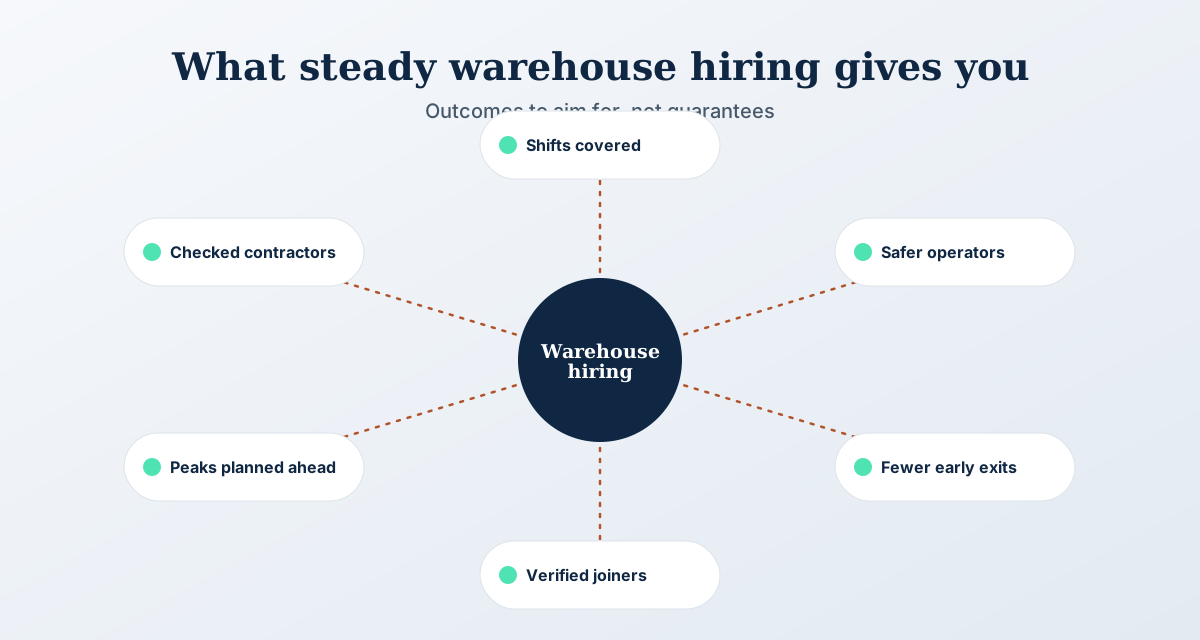
Six parts, each with a clear output.
The scope on one page
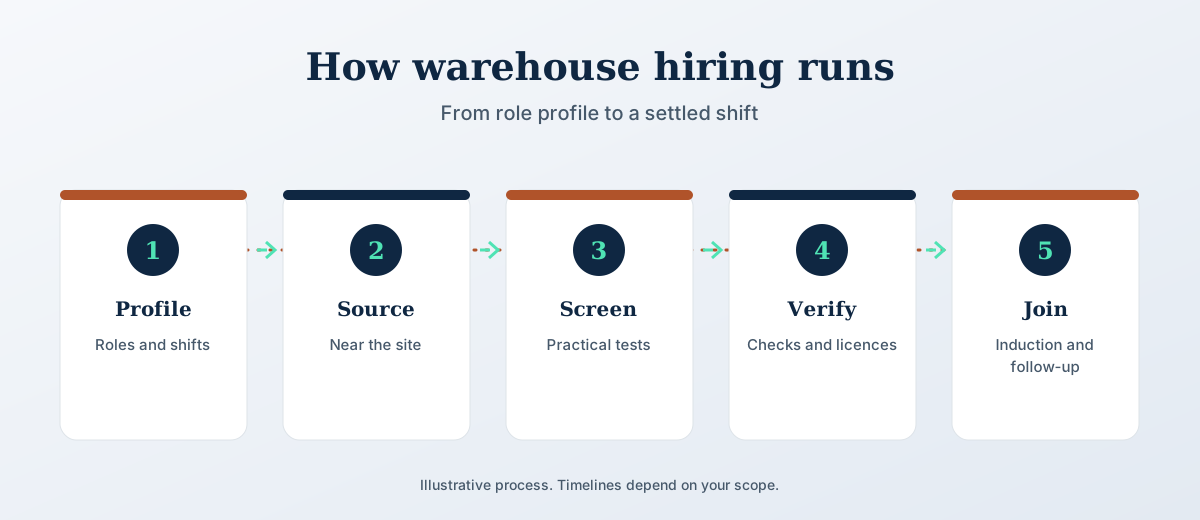
How warehouse hiring runs
Five stages. The scope and timeline are agreed in writing before work starts.
Roles HRBS fills
| Role | What we check |
|---|---|
| Pickers and packers | Pace, accuracy, comfort with scanners and shift timings |
| Loaders and unloaders | Physical fitness for the work, safe lifting, team working |
| Forklift and reach-truck operators | Valid licence or certificate where required, plus a supervised practical check |
| Inventory and WMS executives | Counting discipline, system entries, cycle-count experience |
| Dispatch and receiving coordinators | Documentation, vehicle scheduling, coordination with transporters |
| Shift supervisors and warehouse managers | People handling, shift planning, safety and productivity records |
Planning warehouse hiring for peak season
Festive and sale seasons can double the work for a few weeks. Hiring for a peak works best when it starts early, uses a mix of fixed-term staff, contract workers and returning seasonal staff, and trains people before the rush. HRBS builds a peak plan with you: how many people, from when, on which terms and through which contractors, with the compliance checks for each.
Why warehouse hiring goes wrong
Most problems start before the interview. Job posts promise day shifts when the site runs nights, or leave out the weight of the loads. Candidates are taken from far away because they were available, then leave when the commute wears them down. Tests are skipped in a rush, so people who cannot keep pace join and leave within weeks. Good warehouse hiring is honest about the work, sources close to the site and tests what matters. It takes slightly longer per hire, and it saves the cost of hiring for the same seat three times.
What we need from you
- Site address, shift timings and the number of people per shift
- The roles you need, with the wage range for each
- Any licences or certifications your clients or insurers require
- A contact on site for practical checks and joining days
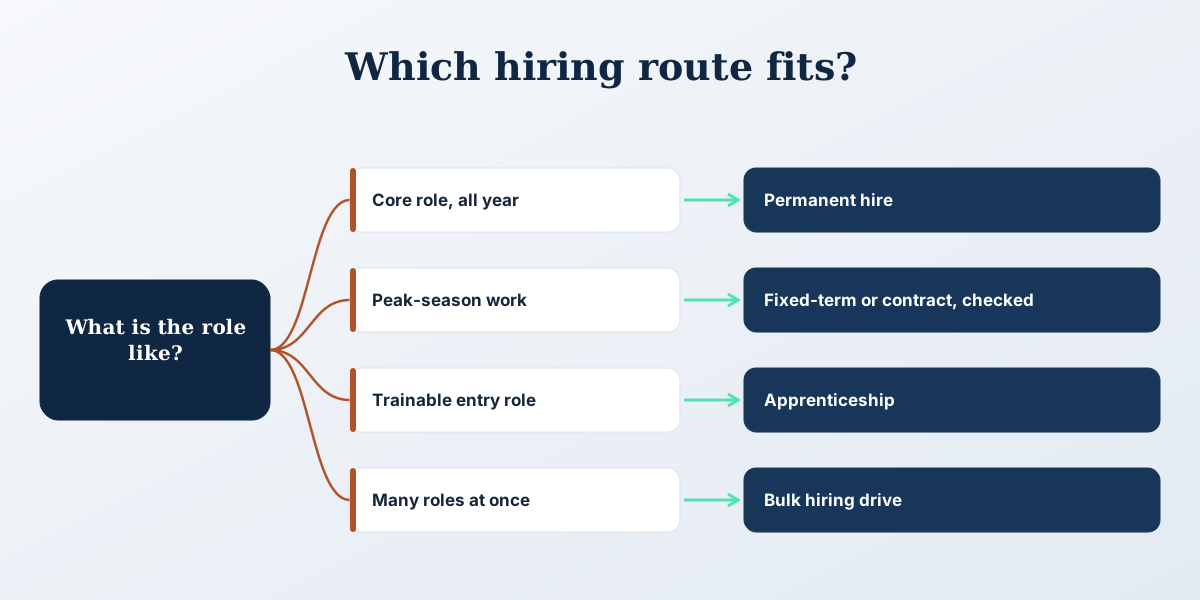
Permanent, contract or apprentice
Core roles such as supervisors, inventory staff and experienced operators usually belong on your payroll. Peak and support work can sit with a contractor, provided the contractor is checked and paid correctly, because the principal employer carries risk too. Some trainable roles suit apprenticeship. HRBS recommends the mix role by role and explains the cost and risk of each.
Measuring whether hiring worked
Joining numbers alone do not show whether hiring worked. For each batch, HRBS tracks how many offered candidates joined on the agreed date, how many were still working after 30 and 90 days, and the reasons people gave for leaving. These figures go to your site manager every week during a drive and every month after it.
When early exits cluster around one shift, one supervisor or one source, the plan changes: a different source, a clearer description of the work, or a conversation with the supervisor. Over time this turns warehouse hiring from a repeated emergency into a planned routine.
Day one on site
The first day decides a lot. HRBS agrees an induction plan with the site: who receives new joiners, which safety briefing they get before entering the floor, which protective equipment is issued, and how attendance is recorded from the first shift. A short check-in at the end of the first week catches problems early, such as a wrong shift, a transport gap or a buddy who was never assigned. These small fixes protect the joining figures the hiring drive worked to reach.
The process in pictures
Three views of how this works: the steps, how to choose, and what to aim for.
Start with a free HR review
A short call about your situation. We tell you what to do first, and you decide whether to work with HRBS.
Book a free HR reviewWarehouse and Logistics Hiring FAQs
Which warehouse roles does HRBS hire for?
Pickers, packers, loaders, forklift and reach-truck operators, inventory and WMS executives, dispatch and receiving coordinators, shift supervisors and warehouse managers. Each role is hired against a profile you approve before sourcing starts.
How do you check forklift operators?
We confirm any licence or certificate the role requires and arrange a supervised practical check at your site or a suitable location. Candidates who cannot operate safely are not put forward, whatever their documents say.
Can you handle festive-season peaks?
Yes. HRBS plans peak hiring with you in advance, including the number of people, start dates, terms and contractor checks, so new staff are trained before the volume arrives rather than during it.
Do you supply contract workers yourselves?
HRBS focuses on hiring and on checking contractors. Where contract labour is the right route, we help you choose and audit contractors so their workers are paid and recorded correctly, because the principal employer carries risk too.
How do you reduce early attrition?
By hiring against realistic role profiles, testing for the actual work, choosing candidates within a practical commute and following up with joiners and supervisors in the first weeks. Problems found early can often be fixed before someone leaves.
Talk to HRBS about warehouse hiring
Book a free HR review. It is a short call, and we tell you what to do first.
Book a free HR review