
Automated applicant tracking system for Indian employers
An applicant tracking system manages candidates from requisition to joining. The HRBS Automated ATS is the portal HRBS uses to serve its own recruitment clients, offered to you as a subscription or as a custom implementation. Request a quote to start.
One portal from requisition to joining.
Hiring managers see live progress, candidates get updates on WhatsApp, and every decision and approval is recorded in one place.
Request a quote →What the ATS includes
Ten features in four groups. Some involve HRBS staff, and we mark those below.
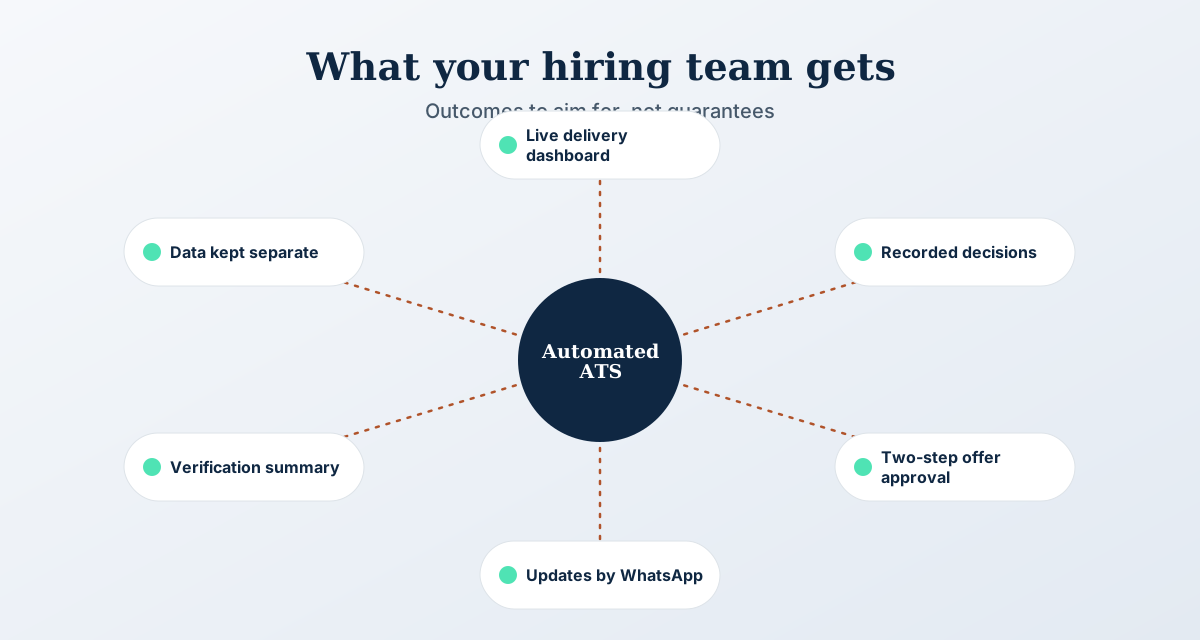
- Live delivery dashboard with requisition tracking and milestones
- One-click employer decision and shortlist review with structured feedback
- Two-step offer approval and a joining tracker
- Pre-vetted candidate dossiers and a malware-scanned CV vault
- A 16-trait behavioural profile from HRBS, calibrated to Sten scores
- Role-specific BARS interview matrix with 1 to 5 competency scales
- A verification summary of identity and employment checks before an offer
- A seven-stage WhatsApp hub that updates candidates at each milestone
- On-demand CHRO advice on compensation and talent scarcity
- Designed around DPDP Act 2023 principles
- Each client's data kept separate, with consent tracking, audit trails and role based access
Two ways to get it
| Option | What you get |
|---|---|
| Subscription | The portal as HRBS runs it, set up for your roles and team. |
| Custom implementation | The portal adapted to your stages, forms and integrations. |
Software and service, stated plainly
Dossiers, verification sign-off and CHRO advice are done by HRBS people. The ATS records and reports on them. We say which is which, so you know what is automated and what is a service.
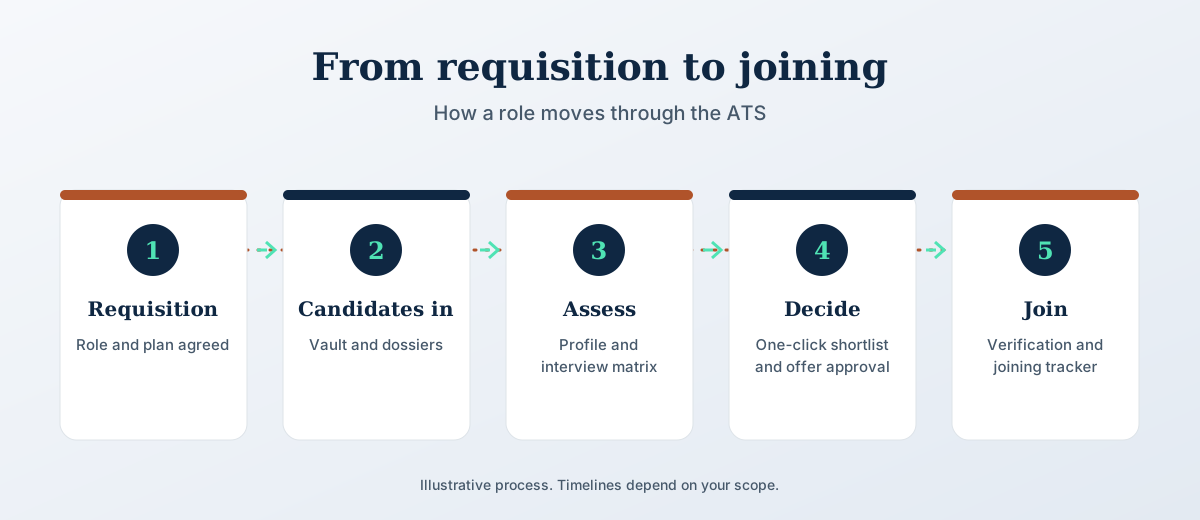
How a hire moves through the applicant tracking system
From the first requisition to the first day, in one record.
Who the Automated ATS suits
It suits employers in India who hire every month, work with HRBS or other recruiters, and want one place to see progress, decisions and offers. It also suits HR teams who need a record of consent and approvals for every candidate. It is not built for one-off hiring of a single role.
Getting started
- Request a quote with your hiring volume and roles.
- Choose a subscription or a custom implementation.
- Agree stages, message wording and approval rules.
- Train hiring managers in a short session, then go live.
The process in pictures
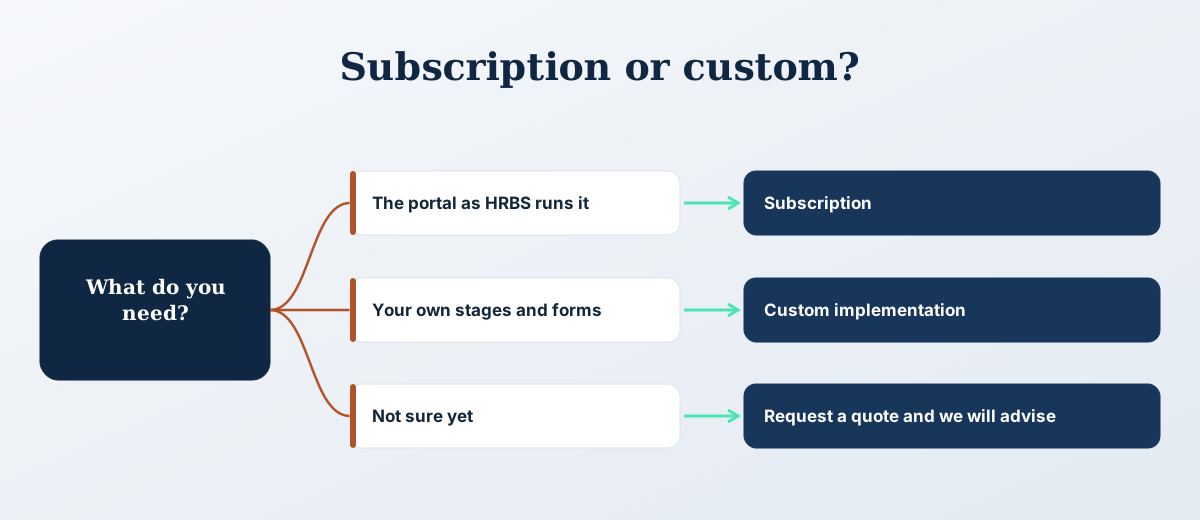
Three views of how this works: the steps, how to choose, and what to aim for.
Automated ATS FAQs
What is an automated ATS?
An applicant tracking system records every candidate and role, moves each person through defined stages, and reports on progress. An automated one also sends updates, collects decisions and tracks offers without manual follow-up.
Is this the same tool HRBS uses?
Yes. The HRBS ATS portal is what HRBS uses to serve its own recruitment clients. You can use it as a subscription, or have it adapted through a custom implementation.
Which parts are software and which are HRBS service?
The dashboard, candidate vault, decision tools, offer workflow and WhatsApp updates are software. Verification sign-off, CHRO advice and candidate dossiers involve HRBS staff and are offered as services.
What is the 16-trait profile?
It is HRBS's own assessment of 16 behavioural traits. It is an HRBS instrument and supports interviews. It does not replace them, and we do not claim it is clinically validated.
How is candidate data protected?
The product is designed around the principles of the Digital Personal Data Protection Act 2023, with each client's data kept separate, consent tracking, audit trails and role based access. Compliance also depends on how you use it.
How do I get a price?
Request a quote. Pricing depends on whether you choose a subscription or a custom implementation, and on your hiring volume.
How do the WhatsApp updates work?
Candidates get a WhatsApp update at each of seven recruitment milestones, so they know where they stand without calling anyone. The milestones and the wording of each message are agreed with you.
Who suits a subscription, and who suits a custom implementation?
A subscription suits employers who are happy to work the way HRBS already runs hiring. A custom implementation suits employers who need their own stages, forms or integrations.
Can hiring managers use it on a phone?
Hiring managers can review shortlists and record decisions from the portal. Confirm the devices your managers use in the quote conversation, so the set-up matches.
What happens to candidate data when we stop?
The exit terms, including export and deletion of candidate data, are agreed in writing before you start, in line with the consent each candidate gave.
Questions to ask any ATS vendor
Put these to every shortlisted tool, ours included.
| Ask | Why it matters |
|---|---|
| Which steps are software and which are done by people? | You need to know what you pay for as a tool and what as a service. |
| Can a hiring manager act without training? | If managers avoid the portal, decisions return to email and WhatsApp groups. |
| How is consent recorded for each candidate? | Under the DPDP Act 2023 you need to show what a candidate agreed to. |
| What can we export, and when? | It decides how easily you can leave and how you report to your management. |
| Who sees which candidate? | Role based access limits who can open salary, feedback and identity documents. |
Who does what
A hire involves three parties. Agreeing this early avoids most delays.
Common mistakes when adopting an ATS
- Copying a ten-stage paper process into the system, when five clear stages would do.
- Skipping the interview matrix, then arguing over feedback that was never written down.
- Leaving the offer approval chain vague, so offers wait on a single inbox.
- Messaging candidates at every stage without agreeing the wording first.
Subscription or custom: three questions
- Do your stages and forms differ from how HRBS runs hiring?
- Must the ATS connect to a system you already use?
- Do you hire often enough to justify the extra set-up?
Two or three yes answers point to a custom implementation. Otherwise start with the subscription. Request a quote and we will confirm.
Common questions
What should I look for when choosing an applicant tracking system?
Look for clear stages, a record of every decision, candidate consent tracking, role based access and easy export. Check that hiring managers can use it without training. Ask which parts are software and which are people, and get the exit terms in writing before you sign.
Do hiring managers need training to use the ATS?
A short session is usually enough, because their tasks are limited to reviewing shortlists, scoring interviews and recording a decision. Training is part of getting started, and we agree the content with you. Managers who skip it tend to revert to email, so attendance matters.
Can a subscription be moved to a custom implementation later?
Possibly, but confirm this at the quote stage rather than assuming. Moving usually means agreeing new stages, forms or integrations and checking how existing candidate records carry over. Ask for the terms and any data migration steps in writing so there are no surprises later.
Get a quote for your hiring volume
Tell us how many roles you fill and which option you prefer. We reply with a plain quote.
Request a quote