
Employee attrition reduction checklist
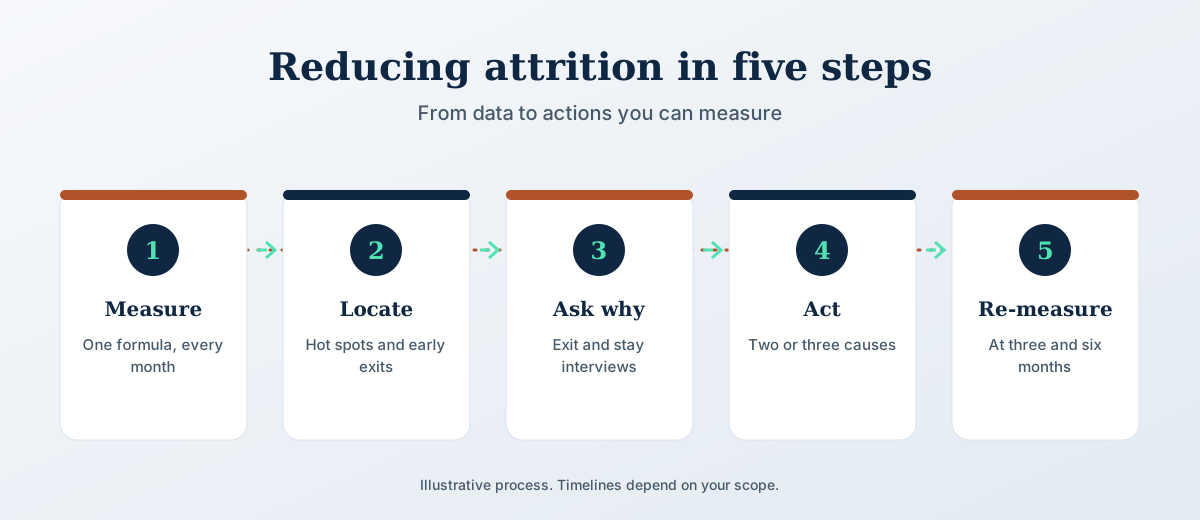
Employee attrition is the share of your people who leave over a period, usually measured as leavers divided by average headcount. Reducing it starts with measuring it the same way every month, finding where people are leaving and why, and acting on the two or three causes that explain most exits. This checklist sets out those steps in order.

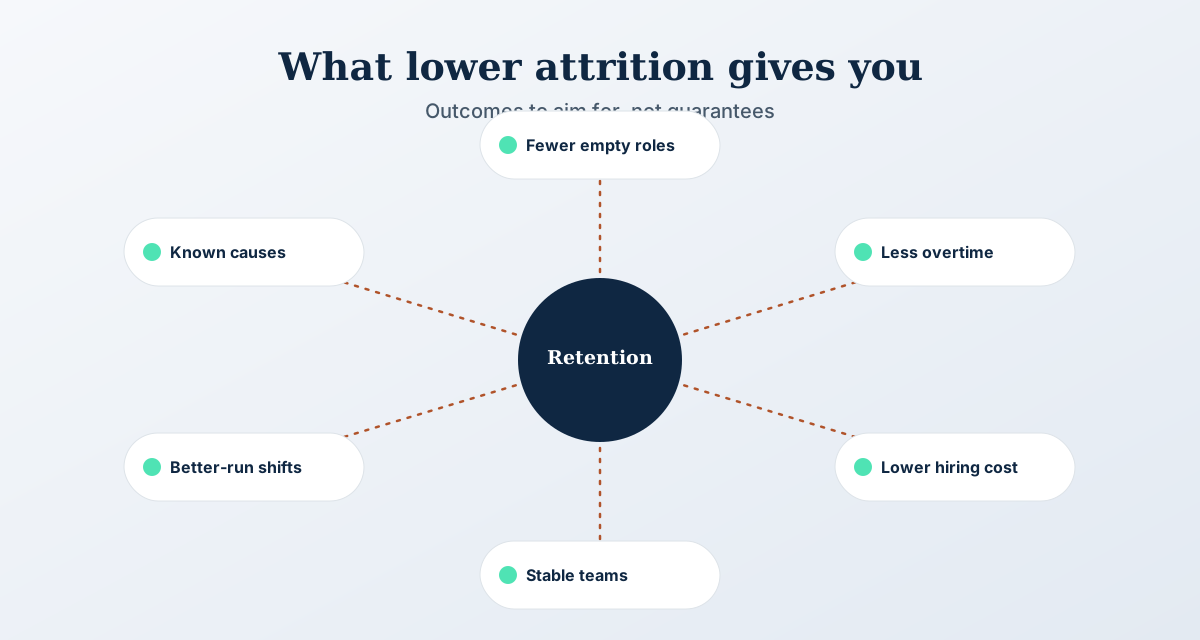
High employee attrition costs more than the recruitment fee. There is the time a role stays empty, the overtime others work to cover it, the training a new joiner needs and the output lost while they learn. Many companies respond with a general engagement survey or a pay rise for everyone. Both can help, but neither works well without knowing where the problem is. The checklist below starts with the data and ends with a small number of actions you can measure.
The checklist
Seven steps, in the order they work best. Tick them off as you go.
1. Measure attrition the same way every month
- Use one formula: leavers in the period divided by average headcount, times 100.
- Report monthly and as a rolling twelve months, so one bad month does not mislead.
- Count contract workers separately from employees.
- Split leavers into voluntary and involuntary exits.
2. Find where people are leaving
- Break attrition down by location, department, manager, role, grade and tenure band.
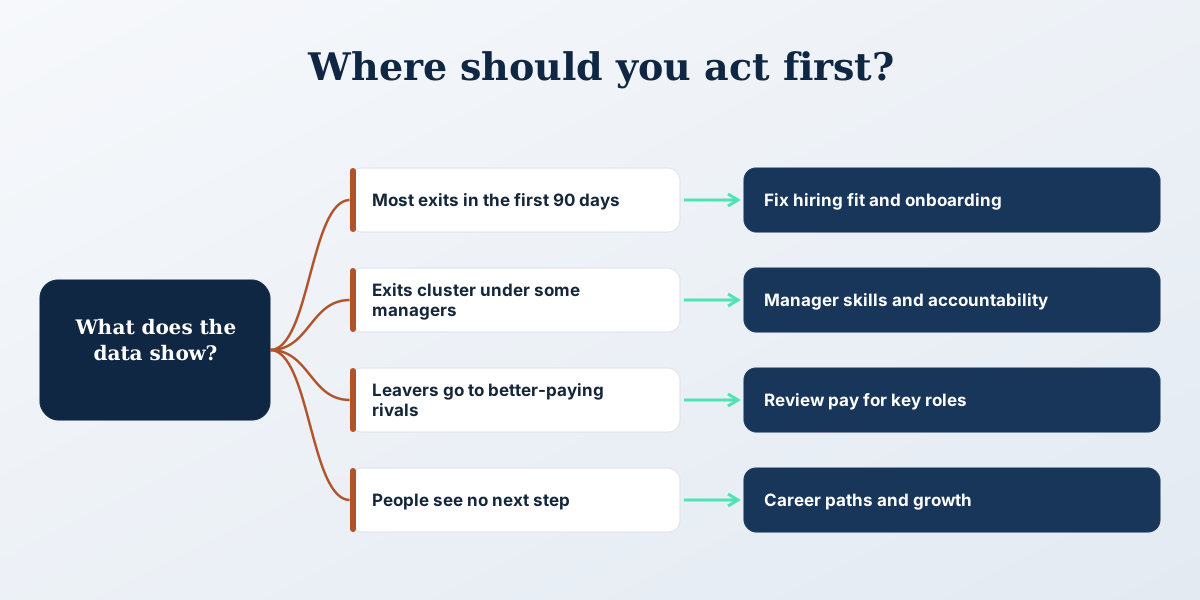
- Track early attrition: people who leave within their first 90 days.
- Mark each exit as regrettable or not, using a rule agreed with managers.
- Look for one or two hot spots; they usually explain most of the total.
3. Ask why, and ask early
- Hold exit interviews with someone other than the line manager.
- Hold stay interviews with people you want to keep, before they resign.
- Group the reasons into a few themes: manager, pay, workload, growth, commute and joining experience.
- Check whether the reasons people give match what the data shows.
4. Fix the first 90 days
- Make sure the job matches what was described at the interview.
- Have the workstation, login, uniform and payroll ready on day one.
- Give every new joiner a named buddy and a check-in in week one and month one.
- Pay the first salary correctly and on time.
5. Look hard at managers
- Compare attrition by manager, not just by department.
- Train supervisors in basic people skills: setting work, feedback, fair rosters and handling complaints.
- Include team retention in how managers are reviewed.
6. Check pay and progression
- Compare pay for key roles with the local market, especially near competitors.
- Make sure pay differences inside a grade can be explained.
- Show people a visible next step, with the skills needed to reach it.
- Recognise good work quickly, in ways people actually value.
7. Act, then measure again
- Pick two or three actions for the biggest hot spots, not ten for everything.
- Give each action an owner and a date.
- Review the same measures after three and six months, and keep what works.
Signs attrition needs attention now
- The same roles are advertised again within a few months.
- Many people leave before their first salary or soon after it.
- One manager or one shift loses far more people than others.
- Overtime keeps rising although headcount is meant to be stable.
- Good performers resign and give pay or growth as the reason.
- Nobody can say the attrition figure for last quarter with confidence.
Common causes we see
In plants and operations teams, early attrition often comes from a gap between the job described at hiring and the job on the floor, long commutes, shift patterns that change without notice, and wages paid late or with errors. In office roles, the usual themes are the immediate manager, unclear growth and pay that has drifted below the market. These are patterns, not rules. Your own data and exit reasons decide which apply to you.
Use the checklist yourself, or with HRBS
You can work through this employee attrition checklist with your own HR team. If you would rather have help, HRBS offers a free HR review: you share your leaver data and headcount, and we tell you where the hot spots are and which two or three actions to try first. If the cause turns out to be pay structure, manager capability or hiring quality, the related services below go deeper.
Using the checklist every quarter
The checklist works best as a routine, not a one-time exercise. Run it once to set a baseline, then repeat it each quarter with the same definitions so the figures can be compared. Keep the list of actions short, give each one an owner, and check at the next review whether it was done and whether exits fell in the group it targeted.
If employee attrition does not move after two quarters, the cause is probably not the one you fixed, and the exit data deserves a second, closer reading. HRBS can run the first review with you and then hand the routine over to your HR team.
The process in pictures
Three views of how this works: the steps, how to choose, and what to aim for.
Start with a free HR review
A short call about your situation. We tell you what to do first, and you decide whether to work with HRBS.
Book a free HR reviewEmployee Attrition Reduction Checklist FAQs
How do you calculate employee attrition?
Divide the number of leavers in a period by the average headcount for that period and multiply by 100. Use the same formula every month, report a rolling twelve-month figure as well, and count contract workers separately.
What is a good attrition rate?
It depends on the industry, the role and the location, so a single benchmark can mislead. A more useful test is whether your rate is falling, whether regrettable exits are low, and how it compares across your own sites and managers.
What causes early attrition in the first 90 days?
Common causes are a job that differs from what was described at hiring, a poor first week, long commutes, unexpected shift changes and first-salary errors. Fixing hiring fit and onboarding usually has the quickest effect.
Are exit interviews worth doing?
Yes, if someone other than the line manager runs them and the reasons are grouped and reviewed every quarter. Stay interviews with people you want to keep are often more useful, because they find problems before a resignation.
Can HRBS review our attrition data?
Yes. Through a free HR review, HRBS looks at your leaver data and headcount, finds the hot spots and suggests two or three actions to try first. Deeper work on pay, managers or hiring is scoped separately.
Talk to HRBS about employee attrition reduction checklist
Book a free HR review. It is a short call, and we tell you what to do first.
Book a free HR review