
Total Rewards and Job Grading
Total rewards is everything an employee receives for the work: base pay, variable pay, benefits and recognition. Job grading ranks roles by their size so pay can follow a logic. HRBS designs grades, pay structures and benefits so that pay is explainable, fair across roles and affordable for the business.

What Total Rewards and Job Grading includes
Six areas, each with a clear output.
The scope on one page
Signs you need this
If several of these sound familiar, this service is worth a conversation.
- A new hire earns more than the person training them.
- Promotions come with whatever increase was negotiated.
- Managers cannot explain why two similar roles are paid differently.
- Bonus is paid every year whatever the results.
- Benefits have grown over time with no review.
- An investor or buyer has asked for your pay structure.
Questions to ask any provider
Use these to judge HRBS or anyone else. A good provider answers each one plainly before work starts.
- Which job evaluation method will you use, and why?
- Where will market reference points come from?
- Will you model the payroll cost before we commit?
- How will people below a band minimum be handled?
- How will managers be trained to explain the new structure?
Common mistakes with pay and grading
Four patterns we see often. Each is cheap to avoid and costly to fix later.

Who it suits
It suits companies where pay has been set case by case, where a new hire earns more than the person who trains them, or where a promotion has no clear pay rule. It also helps before a funding round, a listing or a merger, when pay structure will be examined.
What you receive
- A job description and evaluation score for each role in scope
- A grade structure and a salary band for each grade
- A cost model showing the effect on payroll before you commit
- Rules for promotion, increments and offers within the bands
- A communication pack for managers and employees
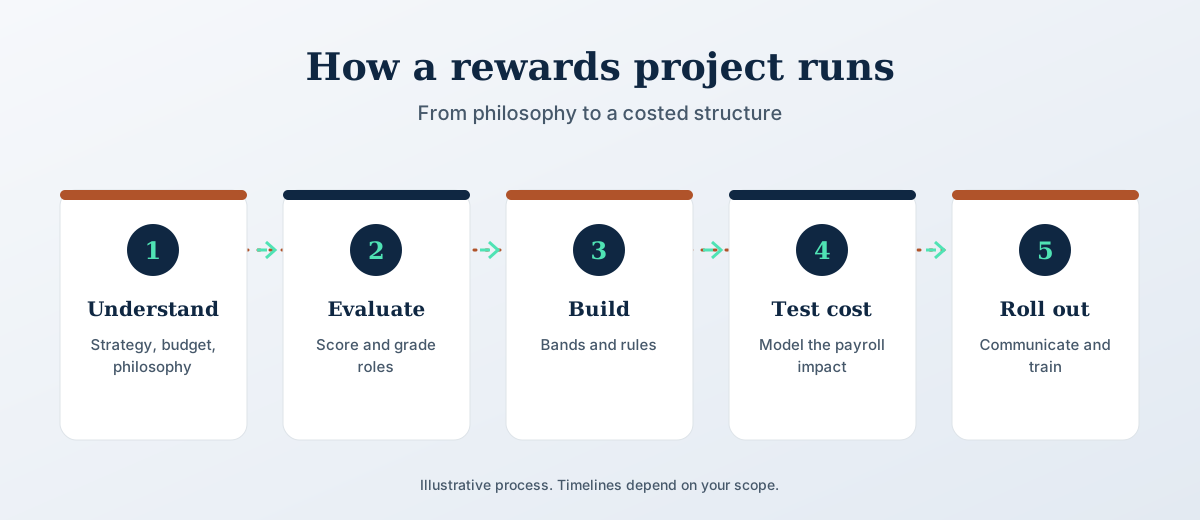
How Total Rewards and Job Grading works
Five steps. The scope and timeline are agreed in writing before work starts.
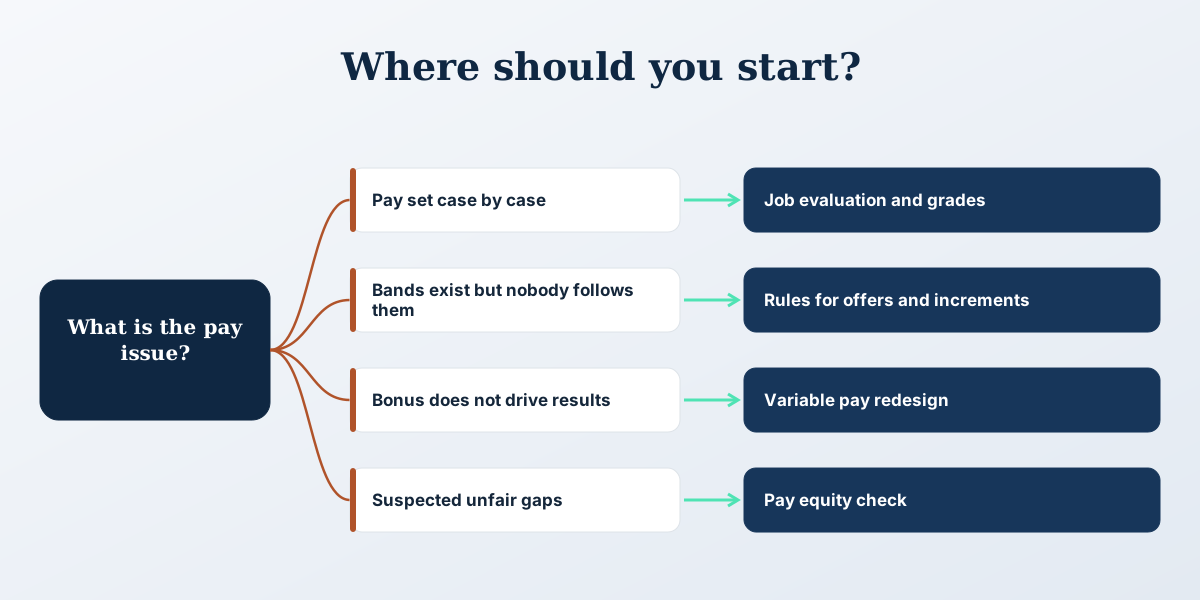
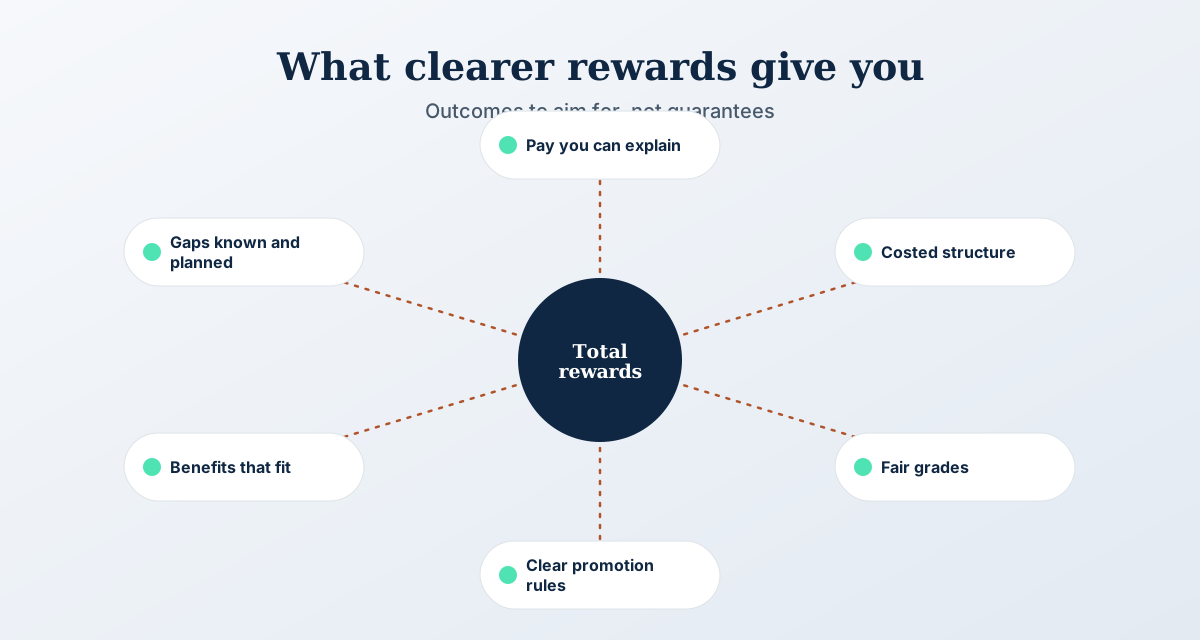
The process in pictures
Three views of how this works: the steps, how to choose, and what to aim for.
Why it matters
Pay disputes seldom start with the amount. They start when someone cannot see why a colleague earns more. A grading structure gives managers a reason they can say aloud, and gives you a way to price a new role without negotiating from scratch. The cost model matters just as much. A structure that looks fair but costs a fifth more than your payroll will not survive the first budget review. We test the cost before anything is announced, so the design you present is one you can afford.
What we need from you
- A list of roles with current pay and reporting lines
- Existing job descriptions or role summaries
- Your pay budget and any market reference data you hold
- Current benefits and their cost
Not included
- A purchased salary survey. HRBS gives reference points from sources you hold or buy, and does not sell pay datasets
- Individual pay decisions, which stay with you
- Tax or legal opinions on benefits
Total Rewards and Job Grading FAQs
What is job grading?
Job grading ranks roles by their size and value to the business, then groups them into grades. Each grade has a pay band, so pay follows a logic instead of case by case negotiation.
What is the difference between job evaluation and a salary survey?
Job evaluation measures the size of a role inside your business. A salary survey shows what other employers pay. A good structure uses both, with evaluation setting the order and the survey setting the level.
Do you provide market salary data?
HRBS gives reference points from sources you already hold or buy. It does not sell a salary dataset, and it says where a reference is thin.
Will the new structure raise our payroll cost?
Not necessarily. The cost model shows the effect before you commit, including the cost of moving people below the band minimum, so you can phase changes.
How many grades should a company have?
It depends on size and structure. Fewer grades are easier to manage, but too few blur real differences in role size. The design stage settles the number with your data.
Can this be done for part of the company?
Yes. Many clients start with one function or one level, such as managers, and extend later.
What is total rewards?
Total rewards is everything an employee receives for their work: pay, bonus, benefits, leave, recognition and learning. Looking at all of it together shows what the business really spends and what employees value.
Do we have to publish pay bands?
No. Some employers share bands with all staff, others only with managers. HRBS helps you decide what to share and trains managers to explain it.
How a grading decision actually gets made
Behind every grade is a short chain of judgments. Knowing the chain helps you challenge it.
When to regrade a role
Grades should move rarely. These situations are the usual reasons to look again.
What to prepare before an engagement
A grading project moves faster when the basics are gathered first. None of this has to be polished.
- An organisation chart that shows who reports to whom, with locations
- The list of roles in scope and the people holding them
- Current pay by role, including fixed, variable and allowances
- Any job descriptions you hold, even if they are old or partial
- A short note on pay decisions you already know are awkward
- The name of one senior person who can settle disputes about role size
Who it suits, and who it does not
It suits businesses with enough roles that pay can no longer be held in one person's head, usually from the point where several managers make offers on their own.
It is a poor fit if you have a handful of employees and one decision maker, if you want grades created to justify pay that is already fixed, or if you expect a new structure to remove every pay complaint. Grading explains pay. It does not end negotiation.
If you are unsure
Start with one function and read our HR strategy, performance and culture overview, or ask for a call through the contact page.
More mistakes to avoid
Beyond the four above, these show up once a structure is live.
Common questions
Should job titles decide the grade?
No. The grade should come from what the job demands: decisions, accountability, knowledge and the people or money it affects. Titles vary between companies and often reflect status. HRBS evaluates the content of the role first, and titles are aligned to grades afterwards, which keeps the structure steady when names on doors change.
How do we handle employees paid above their grade band?
Usually by holding their pay without further increments until the band catches up, or by redesigning the role if it has grown. The right route depends on cost and fairness. The cost model shows each option and its price before you decide, and managers get clear wording to use with the people affected.
How often should grades be reviewed?
Check new and changed roles every year, and review the full structure every few years or after a major change such as an acquisition or new plant. Constant regrading weakens trust, so most roles should keep their grade between reviews, and changes should rest on a documented change in the job.
Can a manager ask us to regrade a role to keep an employee?
A manager can raise the request, but retention alone is not a reason to change a grade. If the job has grown, evaluate it again. If only the person has grown, use a promotion, a movement within the band or a different role. Each route keeps the grade structure honest.
What does a job grading project need from our HR team?
An organisation chart, a list of roles with current pay, existing job descriptions and one senior decision maker. HR also joins the scoring panel and owns the structure afterwards. We agree the time needed from your team in writing before work starts, so nothing surprises you.
Talk to HRBS about Total Rewards and Job Grading
Book a free HR review. It is a short call, and we tell you what to do first.
Book an HR review