
Succession Planning
Succession planning decides who could fill your most important roles, how ready they are and what each needs to be ready. HRBS helps you list critical roles, assess people on performance and potential, name successors, and build development and emergency cover plans.

What Succession Planning includes
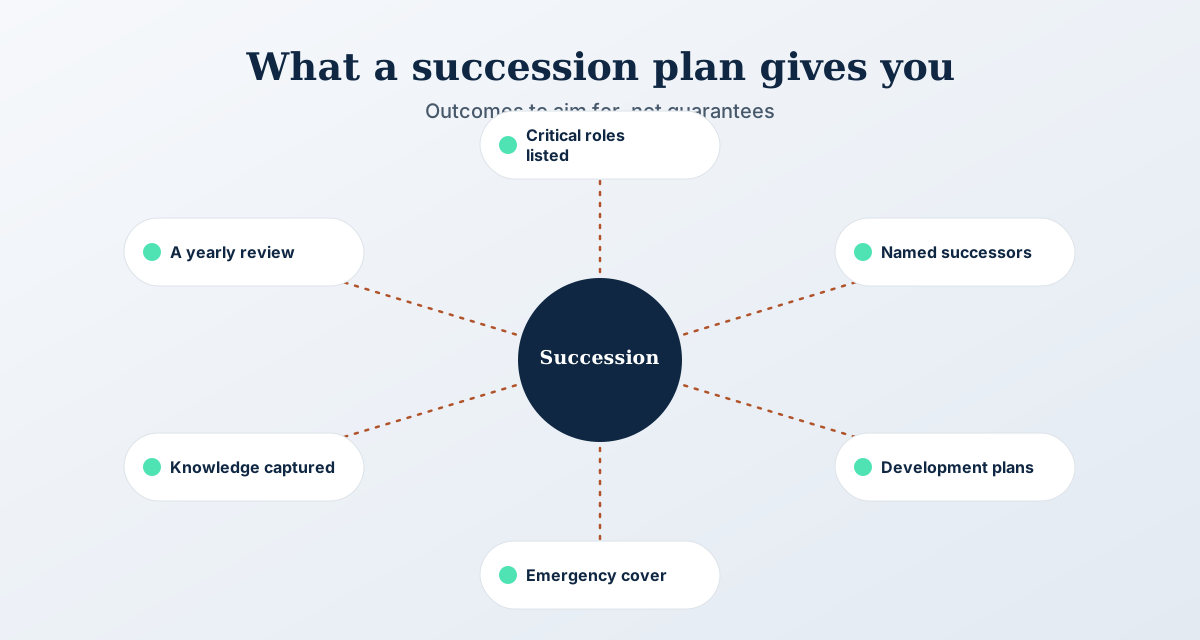
Six areas, each with a clear output.
The scope on one page

Signs you need this
If several of these sound familiar, this service is worth a conversation.
- One person holds key customer or plant knowledge nobody else has.
- A senior leader plans to retire within a few years.
- The board has asked what happens if a key person leaves.
- Leadership roles are always filled from outside.
- High performers leave because they see no next step.
- The promoter wants to step back but has no plan.
Questions to ask any provider
Use these to judge HRBS or anyone else. A good provider answers each one plainly before work starts.
- How will you decide which roles are critical?
- How will you assess potential beyond manager opinion?
- How will ratings be calibrated across managers?
- What goes into each development plan?
- Who will own the plan after you leave?
Common mistakes in succession planning
Four patterns we see often. Each is cheap to avoid and costly to fix later.

Who it suits
It suits owner-led businesses where much knowledge sits with the promoter, family firms planning a handover, professionally managed companies with thin leadership benches, and boards who want to see a plan for key roles.
What you receive
- A map of critical roles with a risk rating for each
- A talent review with calibrated ratings and the evidence behind them
- A successor list for each role with readiness and gaps
- A development plan for each named successor
- A yearly review calendar and an owner for the process
How Succession Planning works
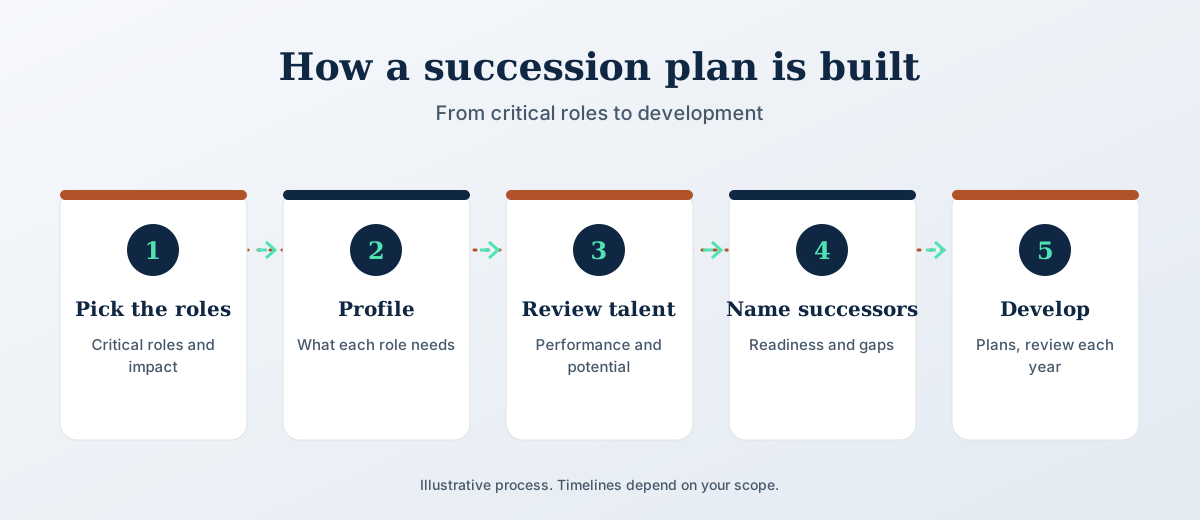
Five steps. The scope and timeline are agreed in writing before work starts.
The process in pictures
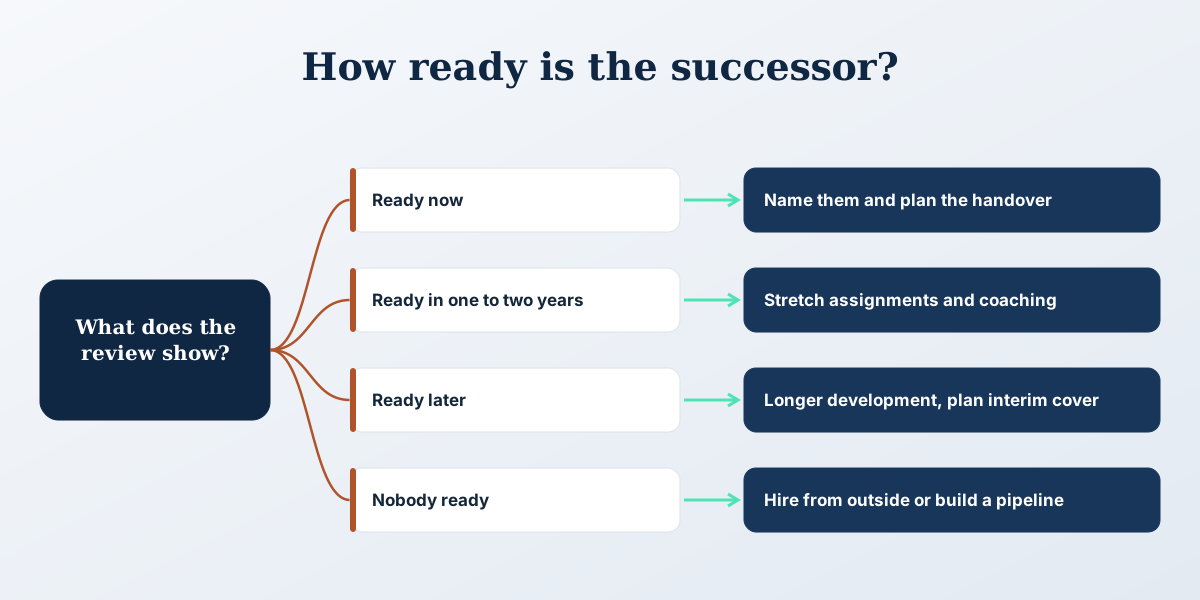
Three views of how this works: the steps, how to choose, and what to aim for.
Why it matters
Succession planning is easy to postpone because nothing breaks today. The cost arrives when a key person resigns or falls ill and nobody has been prepared. Companies then hire in a hurry, often at a premium, or promote the nearest person with no support. A simple plan changes that. It does not need a complex system. It needs a short list of roles, an honest view of the people, and a development plan for each successor. Owner-led firms gain most, because the plan also forces clear decisions about what only the promoter knows.
What we need from you
- An organisation chart with names and tenure
- Performance history for managers and senior staff
- The business plan for the next three years
- Any existing talent or succession notes
Not included
- Decisions on who gets promoted, which stay with you and the board
- Assessment of family members unless the family agrees in writing
- Guarantees that a successor will accept or stay
Succession Planning FAQs
What is succession planning?
It is the process of preparing people to fill key roles when the current holders leave, retire or move. It covers identifying roles, assessing people, naming successors and developing them.
Which roles need a succession plan?
Roles whose loss would hurt most and take longest to fill. These are usually leadership roles, but also include rare technical roles and positions holding key customer or plant knowledge.
How do you assess potential?
Through evidence: results, learning speed, behaviour under pressure and feedback from several people. Managers' ratings are compared across the company so one strict or generous manager does not skew the picture.
Is this useful for a family-owned business?
Yes. It helps separate the roles the family wants to keep from those open to professional managers, and it plans the transfer of knowledge held by the promoter. Family members take part only with their agreement.
What if no internal successor is ready?
The plan says so and shows what to do: develop someone, hire from outside, or arrange interim cover. Knowing the gap early gives you time to act.
How often should the plan be reviewed?
At least once a year, and whenever a key person changes role. The yearly review calendar is part of the deliverable.
Should successors be told they are on the list?
It depends on your culture and the role. Many employers tell people they are in a development pool without promising a specific job. HRBS helps you decide and plan the conversation.
Is this only for large companies?
No. A small or family business often carries more risk, because one person may hold key customer or plant knowledge. A simple plan for a few roles is enough to start.
How to identify critical roles
A role is critical because of what its loss would do, not because of its title or its pay.
Readiness levels explained
Readiness describes when a person could step into a role. It is a judgment about the next job, not a score of how good they are today.
The timings are guides. Agree your own definitions at the start so every manager rates the same way, and write the evidence beside each rating.
From role mapping to development plans
A working sequence for a first round. It can be run on a handful of roles.
- List the critical roles and rate each for impact and likelihood of a vacancy.
- Write a one-page profile for each: purpose, key decisions, relationships, knowledge held.
- Gather evidence on candidates from results, several managers and past assignments.
- Hold a review meeting where managers explain and defend their ratings to each other.
- Name successors with a readiness level, and name the emergency cover.
- Agree one or two real assignments for each successor, plus support from a senior mentor.
- Record the plan, set the review date and name the owner.
What owners of family and founder-led businesses should ask
These questions are uncomfortable, which is why they are worth answering early.
- Which decisions only I make, and could any be handed over this year?
- Which relationships exist only with me, and how do I introduce someone else?
- Is the next leader expected to come from the family, or is the role open?
- If a family member is a candidate, what does the same evidence say about them as about an outsider?
- What would the senior team need to see before accepting a successor?
- Who will tell the people who are not chosen, and when?
More succession planning mistakes
These come up after the first plan is written.
Is it the right time?
If a key person could leave within three years, or the board has asked about cover, start now with a small scope. A first round on three to five roles is enough to show where the gaps are. If you are unsure where to begin, you can book a short call through the contact page, or read about wider HR consultation and CHRO as a service.
Common questions
What is the difference between succession planning and replacement planning?
Replacement planning names a stand-in for a vacancy and stops there. Succession planning looks further: it assesses potential, rates readiness and builds development plans so people grow into larger roles over time. Many firms start with replacement cover and add development later when time allows.
How many successors should we name for a critical role?
Two or three where possible, at different readiness levels, plus someone for emergency cover. One named successor leaves you exposed if that person leaves or declines. In a small firm the bench may be thin, and the plan should say so openly, with a note on where to hire or develop.
What does readiness mean in a succession plan?
Readiness is how soon a person could take a specific role, such as ready now, in one to two years, or in three to five. It is a judgment about the next job against the role profile, backed by written evidence, not a general rating of the person or a promise of promotion.
How do we start succession planning with a small team?
Pick three to five roles whose loss would hurt most. Write a short profile for each, discuss candidates with senior managers, name emergency cover and agree one development assignment per successor. That first round takes little time and shows where the real gaps are, without a large project.
How do we plan succession when the founder is the key person?
Start by listing the decisions, relationships and knowledge only the founder holds. Move them across in stages to named people, with a shared period before any exit. The plan also settles which roles stay with the family and which are open to professional managers, so the family and senior team know where they stand.
Talk to HRBS about Succession Planning
Book a free HR review. It is a short call, and we tell you what to do first.
Book an HR review