
HR Due Diligence and IPO Readiness
HR due diligence is a review of a company's people obligations before a sale, investment or listing. HRBS examines employment contracts, statutory compliance, contractor arrangements, dues and disputes, and key people risks, then reports what a buyer or investor is likely to ask about. HRBS is an HR consultancy, and legal opinions come from qualified counsel.

What HR Due Diligence and IPO Readiness includes
Six areas, each with a clear output.
The scope on one page
Signs you need this
If several of these sound familiar, this service is worth a conversation.
- A funding round, sale or merger is planned within a year.
- You are preparing for a listing.
- Employment contracts vary and some cannot be found.
- Contractor licences and payments have never been checked.
- Gratuity and leave liabilities are not calculated regularly.
- Open disputes or notices have no single tracker.
Questions to ask any provider
Use these to judge HRBS or anyone else. A good provider answers each one plainly before work starts.
- Which entities and locations will the review cover?
- How will findings be rated by severity?
- How will accrued liabilities be calculated and supported?
- When will you bring in legal counsel, and who pays for it?
- Will you help fix the gaps, or only report them?
Common mistakes in HR due diligence
Four patterns we see often. Each is cheap to avoid and costly to fix later.

Who it suits
It suits founders preparing to raise funds, companies planning a listing or a sale, buyers and investors who want an HR view of a target, and groups merging operations. It also helps companies who want to find and fix gaps before anyone else looks.
What you receive
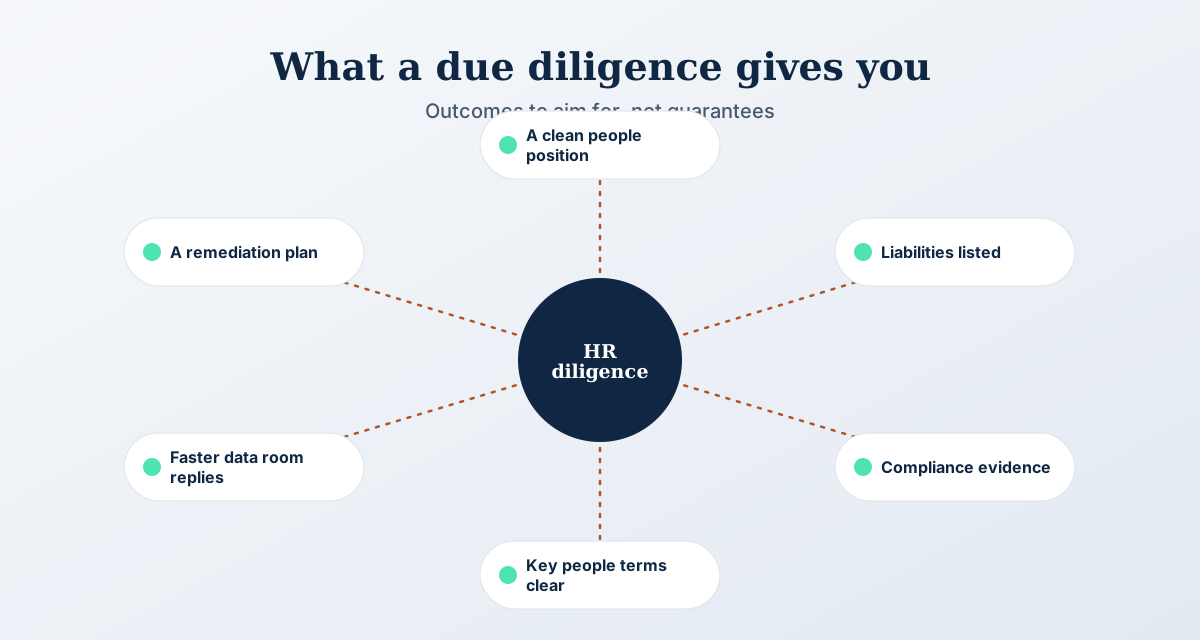
- A findings report with each issue rated by severity and the source document
- A schedule of accrued people liabilities with the basis of each figure
- A list of the documents a buyer or investor is likely to request
- A remediation plan with owners and sequence
- A summary suited to sharing with the deal team or board
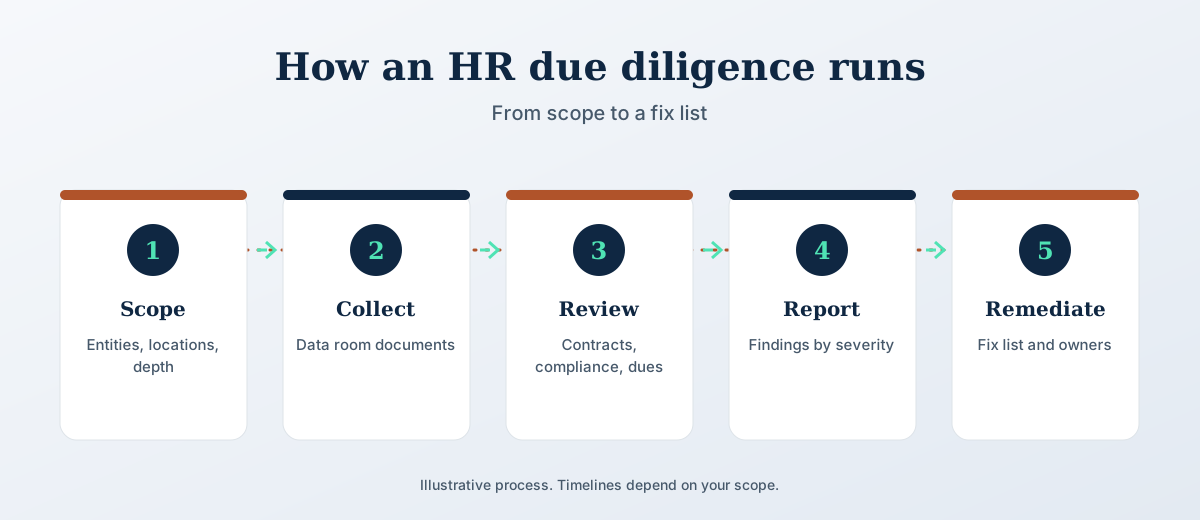
How HR Due Diligence and IPO Readiness works
Five steps. The scope and timeline are agreed in writing before work starts.
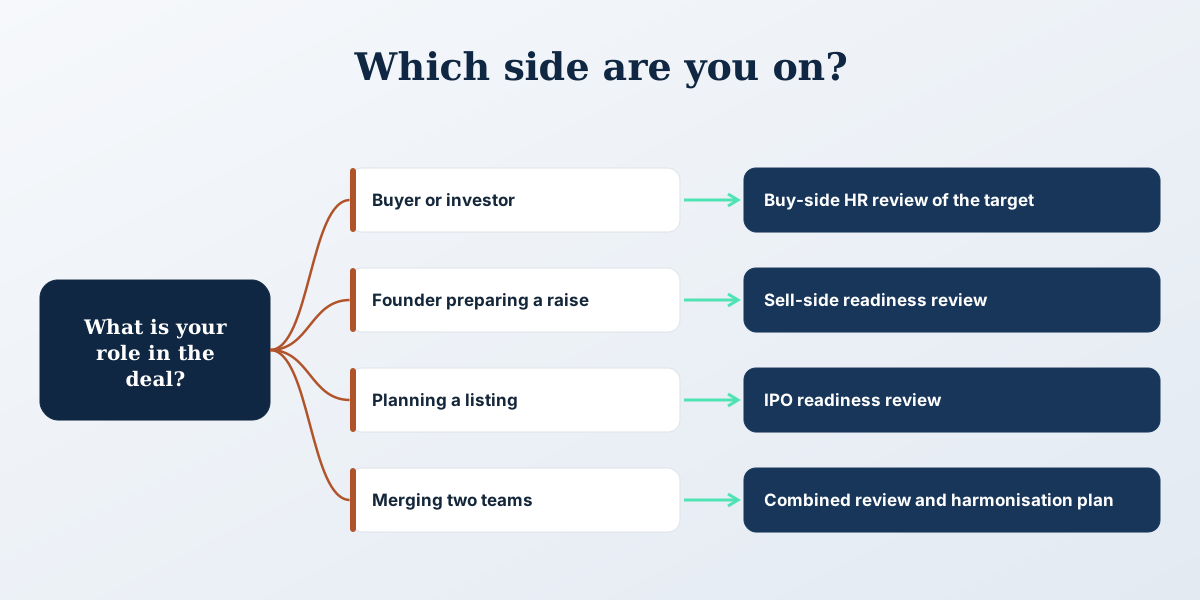
The process in pictures
Three views of how this works: the steps, how to choose, and what to aim for.
Why it matters
People issues rarely stop a deal, but they move price and terms. An unrecorded liability, a contractor without a licence or a missing consent shows up late and costs more to explain than to fix early. Sell-side preparation works in the same way: the company that has already checked its records answers questions in days, not weeks. A listing raises the bar further, because disclosures about key managers, incentives and compliance become public. A structured review turns scattered documents into a clean position you can defend.
What we need from you
- Employment contract templates and a sample of signed contracts
- Compliance registers, returns and payment proofs
- Contractor agreements and licences
- A list of disputes, notices and settlements
Not included
- Legal opinions, which come from qualified counsel that HRBS can coordinate with
- Valuation or financial due diligence
- Negotiation of deal terms
HR Due Diligence and IPO Readiness FAQs
What is HR due diligence?
It is a review of a company's people obligations, covering contracts, compliance, contractors, liabilities, disputes and key people, usually before a sale, investment or listing.
Who needs it?
Buyers and investors reviewing a target, founders preparing for a funding round, companies planning to list, and any business that wants to find its own gaps before others do.
Is HRBS a law firm?
No. HRBS is an HR consultancy. Where a legal opinion is needed, qualified counsel provides it and HRBS coordinates so you deal with one team.
What does IPO readiness cover from an HR point of view?
It covers clean contracts and records, compliance evidence, a clear position on dues and disputes, key management terms and incentive plans, so disclosures can be made accurately. Listing rules change, so check the current requirements with your advisers.
Can you work inside a data room?
Yes. HRBS works from the documents you share, under a confidentiality agreement, and keeps a record of what was reviewed.
How long does it take?
It depends on the number of entities, locations and documents. The scope and timeline are agreed in writing after a short call.
What documents are needed for HR due diligence?
Usually employment contracts, policies, compliance registers and returns, payment proofs, contractor agreements and licences, and a list of disputes and notices. The exact list depends on the deal and the entities in scope.
What happens after the findings report?
HRBS can help fix the gaps in order of severity, with owners and dates, so the position you present to investors or buyers is one you can support.
Can a small company have a due diligence review?
Yes. The scope is smaller and the review faster, but the questions are the same: are contracts, compliance and liabilities in order.
HR due diligence checklist by area
A reviewer, whether a buyer, an investor or your own team, tends to ask for the same papers. Gather these first and the rest of the review moves faster.
Records and contracts
- Appointment letters for each grade, plus signed copies for a sample of staff
- Handbook, code of conduct and key policies, with dates of issue
- Notice period, non-compete and confidentiality clauses, and where they differ by person
- Employee master list that matches payroll and the headcount quoted in deal papers
- Evidence of policy acknowledgement, including the prevention of sexual harassment policy and committee records
Statutory compliance
- Registrations for each entity and location, with the law each one relates to
- Monthly and annual returns, with payment challans
- Provident fund, ESI, professional tax and labour welfare fund payment trail
- Inspection reports, notices and replies
Contractors and dues
- List of contractors with licence number, validity and the sites covered
- Wage registers, payment proofs and statutory deposits for contract workers
- Gratuity, leave encashment and bonus working, with the date of the latest calculation
- Any pending salary revisions, arrears or settlement commitments
People and incentives
- Key manager contracts, notice terms and retention arrangements
- ESOP or incentive plan documents, grant letters and a current grant register
- Related-party employment, such as relatives of promoters on payroll
- Open disputes, show-cause notices, settlements and the status of each
HR readiness areas for a listing
A listing puts people matters into documents the public can read. These are the areas HR usually has to support. The exact disclosures and the format are confirmed by your merchant bankers and legal counsel, and they change, so treat this as a preparation list and not a rulebook.
Rating findings: a simple severity guide
A long list of issues helps nobody. Rating each one tells the deal team where to spend time. The scheme below is general practice, and your own report can adjust it.
Every rated finding should name the source document, the person who owns the fix and what evidence closes it. Whether a High item becomes a price point or a condition is a matter for the deal team and counsel, not for the HR report.
Sell-side and buy-side: what changes
If you are the company preparing
- You decide the scope, so start with the entities and sites where records are weakest.
- Fix what can be fixed before the data room opens, and list what cannot, with the reason.
- Prepare short written explanations for known issues so answers are consistent.
- Keep one person responsible for data room uploads and version control.
If you are the buyer or investor
- Agree the scope with deal counsel, then focus HR time on the items most likely to affect terms.
- Ask for signed documents, not only templates, and compare headcount across sources.
- Check contractor and branch coverage, because these are the areas most often left out of the target's own review.
- Ask which findings need a legal opinion and route them to counsel early.
A sensible order of work in the months before
The sequence matters more than the pace. Later steps depend on the earlier ones being done.
Where HR due diligence does not fit
This service is a poor match in a few cases. If you only need a legal opinion on a specific clause or a pending case, that goes to counsel directly. If the question is valuation, tax or financial due diligence, those sit with other advisers. If you want help negotiating deal terms, HRBS does not do that.
It also does not suit a company that cannot yet share any documents, because a review without papers is only a conversation. In that case a smaller step is better: take the HR self-assessment or ask for a free HR review and decide the scope from there.
Common questions
Which HR documents do investors ask for first?
Investors usually start with employee contracts, the employee master list, statutory registrations and returns, contractor licences, and a list of disputes and notices. They also ask for incentive and ESOP records. Having these in one organised folder, with signed copies and a reconciled headcount, saves the most time during review.
How early should a company start HR preparation before a listing?
Start well before the process begins, because gaps in signed contracts, licences and incentive records take time to reconstruct. A common approach is to begin several months ahead, fix the serious items first, keep evidence of each fix, and confirm the timeline with your merchant bankers and legal counsel.
Are contractors really part of an HR diligence review?
Yes. A buyer or investor may look at contractor licences, wage payments and statutory deposits, because a principal employer can carry responsibility for them if the contractor defaults. Leaving contractors out is one of the most common gaps, so list every contractor and site before the review starts.
What is the difference between sell-side and buy-side HR diligence?
Sell-side work is done by the company to find and fix gaps before others look. Buy-side work is done for a buyer or investor to understand the target's people risks. The checks overlap, but the company chooses sell-side scope, while buy-side scope is set with the deal counsel.
Can HR diligence findings change a deal?
Findings can lead the deal team to ask for fixes, explanations or contractual protection, and counsel decides how each one is handled. HRBS reports the issue, the source document and the figure, so the team can decide. We do not predict how any deal or listing will turn out.
Do you review ESOP and incentive plans?
HRBS reviews the HR side: plan documents, grant letters, the grant register and whether they agree with each other. Questions about approvals, tax or securities law go to qualified counsel and your company secretary, and HRBS coordinates with them so the HR papers line up with the legal ones.
Talk to HRBS about HR Due Diligence and IPO Readiness
Book a free HR review. It is a short call, and we tell you what to do first.
Book an HR review