
Industrial Relations
Industrial relations is how an employer deals with workers and their unions: agreements, discipline, grievances and disputes. HRBS advises manufacturers on building steady relations, following a fair process, preparing for negotiations and handling disputes, with qualified counsel brought in where an opinion is needed.

What Industrial Relations includes
Six areas, each with a clear output.
The scope on one page
Signs you need this
If several of these sound familiar, this service is worth a conversation.
- Small complaints keep turning into collective demands.
- Supervisors handle discipline in different ways.
- A wage settlement is coming and the data is not ready.
- Notices or demands have started to arrive.
- Workers say they are not heard by management.
- A new plant is opening and relations start from zero.
Questions to ask any provider
Use these to judge HRBS or anyone else. A good provider answers each one plainly before work starts.
- How will you hear workers' views without taking sides?
- What will the grievance and discipline processes look like?
- How will you cost the demands in a settlement?
- When will you involve legal counsel?
- How will supervisors be trained and followed up?
Common mistakes in industrial relations
Four patterns we see often. Each is cheap to avoid and costly to fix later.

Who it suits
It suits manufacturers with unionised or partly unionised workforces, plants where relations have worsened, employers facing a settlement, and managers dealing with their first dispute. It also suits non-union plants that want to prevent disputes before they form.
What you receive
- A relations assessment with the main issues and their causes
- A written grievance process and a discipline process with templates
- A settlement preparation pack covering data, costing and negotiating positions
- A first-response plan for the early stage of a dispute
- A training session for supervisors and a follow-up review
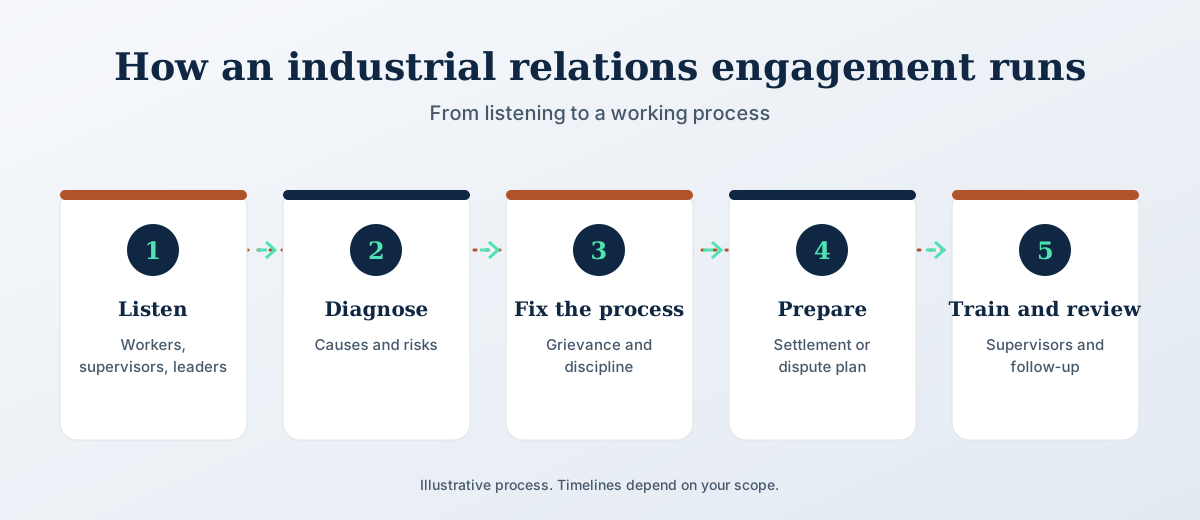
How Industrial Relations works
Five steps. The scope and timeline are agreed in writing before work starts.
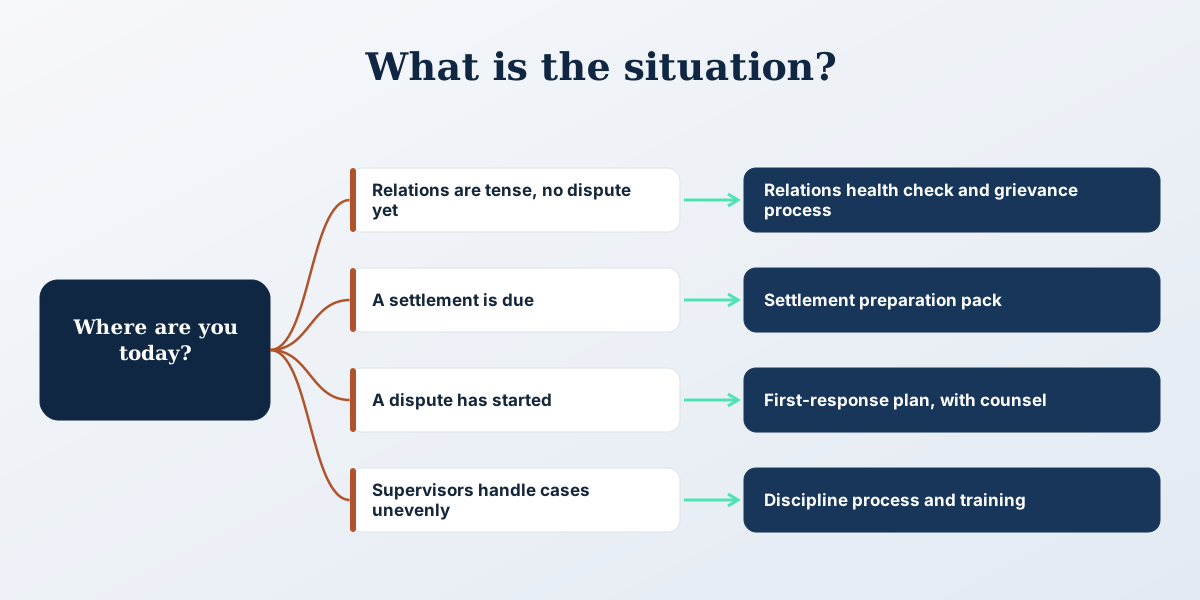
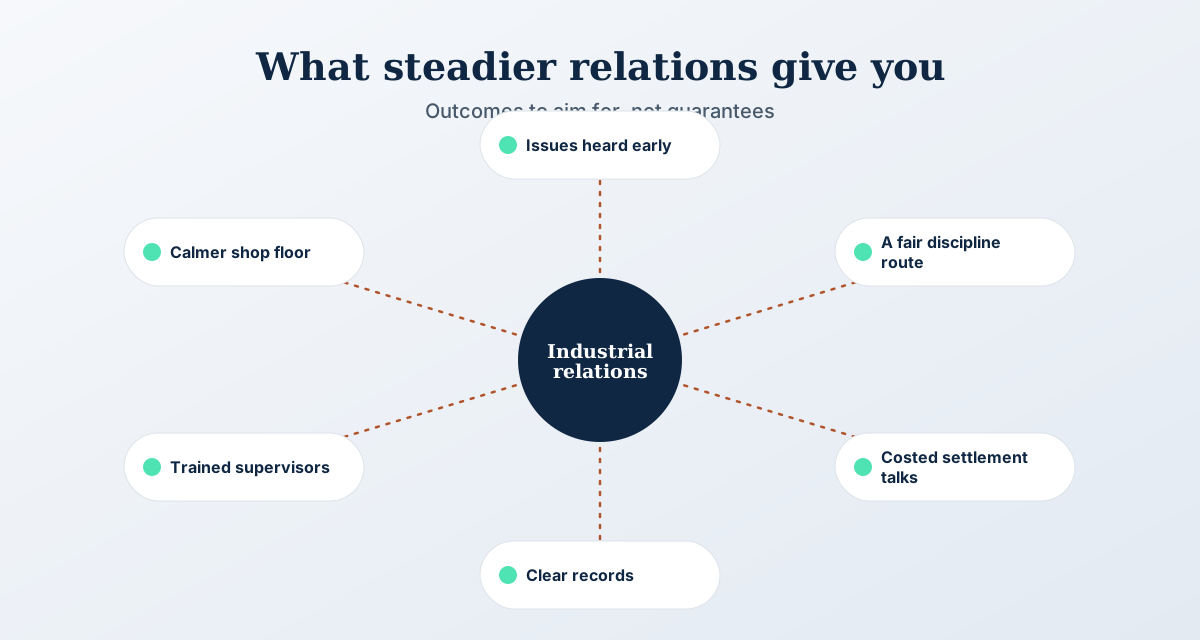
The process in pictures
Three views of how this works: the steps, how to choose, and what to aim for.
Why it matters
Most disputes grow from small things that were not heard: a supervisor's remark, a delayed payment, a rule applied unevenly. By the time a union raises a demand, the complaint has a long history. A working grievance process and a fair discipline process catch problems early and give both sides a record to point to. Preparation matters for settlements too. Talks that begin without costed data usually end in positions neither side wanted. The aim is steady relations and a clean process, so that any dispute is handled on facts.
What we need from you
- Current standing orders, agreements and settlements
- A record of recent grievances, disciplinary cases and notices
- Wage and benefit data for the workforce in scope
- A list of the unions or worker committees involved
Not included
- Legal opinions or representation before a court or tribunal, which come from qualified counsel
- Taking sides in a dispute against your workers' lawful rights
- A guarantee that disputes will not occur
Industrial Relations FAQs
What is industrial relations?
It is the relationship between employers, workers and their representatives, covering agreements, discipline, grievances and disputes. Good practice keeps it fair, documented and predictable.
Do you advise non-unionised plants?
Yes. A grievance and discipline process helps any plant. Preventing disputes is cheaper and quieter than handling them once they start.
Can HRBS represent us in a dispute?
HRBS advises on process and preparation. Legal opinions and representation in proceedings come from qualified counsel, and HRBS coordinates with them.
How do you prepare for a wage settlement?
By building a costed view of the demands, a view of what the business can afford and a negotiation plan with clear limits, before talks begin.
What do the Labour Codes change?
The Industrial Relations Code, one of the four Labour Codes, changes some rules on notices, standing orders and disputes. Rules and state notifications keep changing, so each review states the date it reflects.
How is a supervisor session run?
In a short, practical workshop using real examples from your plant, on what to say, what to record and when to call HR.
What does an industrial relations advisor do?
An industrial relations advisor helps management build fair grievance and discipline processes, prepare for negotiations and respond to disputes. HRBS works alongside your HR team and plant leadership, and brings in counsel for legal matters.
How long does it take to improve relations with workers?
It varies. A grievance process and supervisor training can show results within months, but trust builds slowly and depends on management keeping its commitments.
Can you help after a strike?
Yes. HRBS can help plan the return to work, the communication with workers and the process changes that address the causes, with counsel advising on the legal steps.
A fair grievance process, step by step
Workers use a grievance route only if they believe it is quick and safe. These are the working parts of a process that people actually use.
Discipline: what supervisors should and should not do
Most disciplinary trouble comes from process errors, not from the misconduct itself. The standing orders or service rules in force at your plant set the steps, and your counsel confirms how they apply.
- Note the facts the same day: what happened, who saw it, what was said.
- Do not decide the punishment on the shop floor. Pass the facts to HR.
- Give the worker the allegation in writing and a fair chance to reply.
- Apply the same standard to similar conduct, whoever the person is.
- Keep a file. A step that is not recorded is hard to prove later.
Preparing for a wage or long-term settlement
Talks go better when management arrives with its own numbers. A preparation pack usually covers these points.
- The current wage structure, benefits and the cost of each demand in rupees per month and per year
- The last settlement and how it was reached
- What the business can afford, agreed internally before the first meeting
- Which items are open, which are fixed and who may speak for management
- A communication plan for workers and supervisors during the talks
When a notice or demand arrives
The first week sets the tone. This is a general order of work, not legal advice. Your counsel confirms the legal steps and any response deadlines.
- Log the date and time of receipt and who received it.
- Send the document to HR and the plant head the same day.
- Pass it to your qualified counsel early, because some notices carry fixed response times.
- Agree one spokesperson. Mixed messages from supervisors make things worse.
- Keep operations and attendance records clean, since both sides may refer to them.
Where advisory ends and counsel begins
HRBS advises on relations, process and preparation. We do not give legal opinions, represent anyone before a court or tribunal, or promise an outcome in a dispute or with a union.
- HRBS covers: listening sessions, process design, templates, costing, negotiation planning and supervisor training.
- Your counsel covers: legal opinions, statutory interpretation, formal replies and any proceedings.
- Rules under the Labour Codes and state notifications keep changing, so your counsel confirms what applies to your plant.
Common questions
When should we involve an industrial relations advisor?
Involve one before a dispute, not after. Good moments are a plant opening, a coming settlement, rising complaints or uneven discipline. An advisor helps you set up processes and gather facts early. Once a formal notice arrives, your qualified counsel should be involved too, because some responses have fixed timelines.
Should a company have a written grievance procedure?
A written procedure is good practice for any plant, union or not. It gives workers a safe route and gives management a record. What exact form it must take can depend on your standing orders and applicable rules, so your legal counsel should confirm that before you adopt it.
What should a supervisor record in a disciplinary matter?
Record the date, time, place, what happened, who witnessed it and what the worker said, in plain words and the same day. Do not add opinions or decide the penalty. Hand the facts to HR, who follow the steps in your standing orders and consult counsel where needed.
Talk to HRBS about Industrial Relations
Book a free HR review. It is a short call, and we tell you what to do first.
Book an HR review