
Multi-location HR Operations Audit
A multi-location HR operations audit compares how each of your sites runs HR: hiring, records, attendance, payroll, policies and statutory compliance. HRBS shows where locations differ, which differences create cost or risk, and what a common standard should look like.

What Multi-location HR Operations Audit includes
Six areas, each with a clear output.
The scope on one page
Signs you need this
If several of these sound familiar, this service is worth a conversation.
- Payroll rules differ between sites for the same kind of role.
- Some locations pass audits and others struggle.
- Each site manager runs hiring in their own way.
- Employee files look different from one location to the next.
- You plan a common HRMS or a shared service centre.
- You acquired a business and kept its HR as it was.
Questions to ask any provider
Use these to judge HRBS or anyone else. A good provider answers each one plainly before work starts.
- How many sites will you cover, and how will you sample?
- How will you tell justified local differences from habit?
- Will statutory gaps be listed by state and location?
- What will the common standard cover first?
- Who will own each gap after the audit?
Common mistakes in multi-location HR
Four patterns we see often. Each is cheap to avoid and costly to fix later.

Who it suits
It suits employers with several plants, branches or offices, companies that grew by acquisition, and groups where each site developed its own way of working. It also helps before moving to a common HRMS or a shared service centre.
What you receive
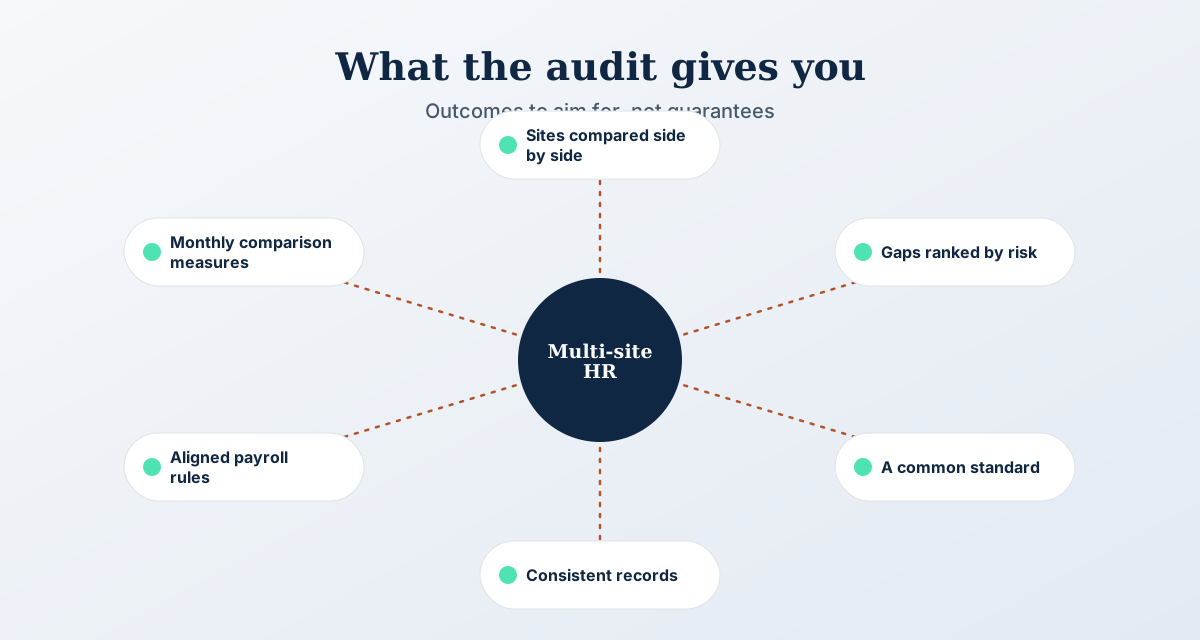
- A location by location comparison table across the areas above
- A list of gaps ranked by risk, with the site and the owner for each
- A proposed common standard for the processes that matter most
- A step by step plan to close the gaps, with sequence and effort
- A short list of measures to compare sites every month
How Multi-location HR Operations Audit works
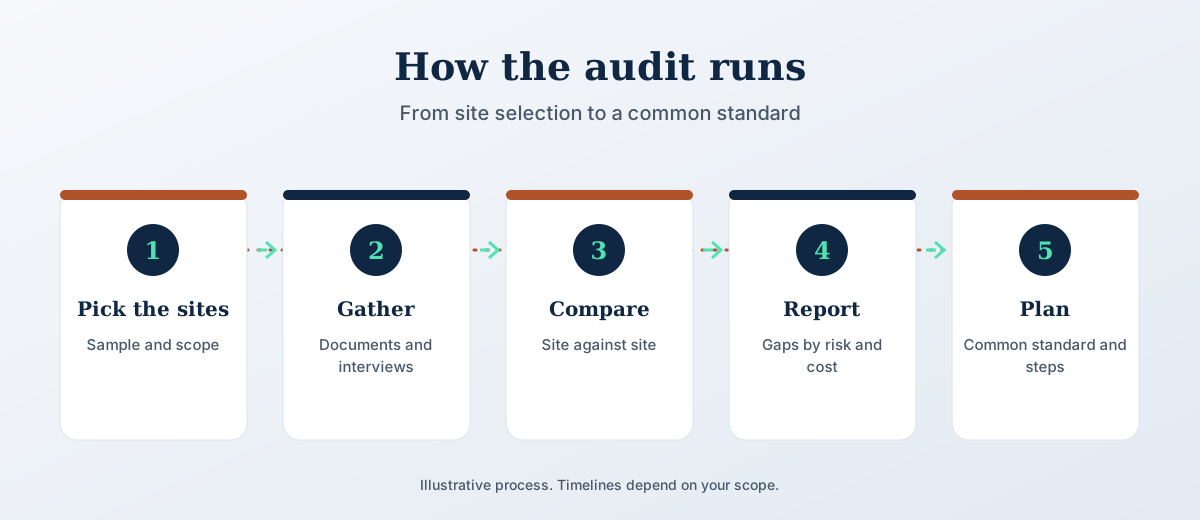
Five steps. The scope and timeline are agreed in writing before work starts.
The process in pictures
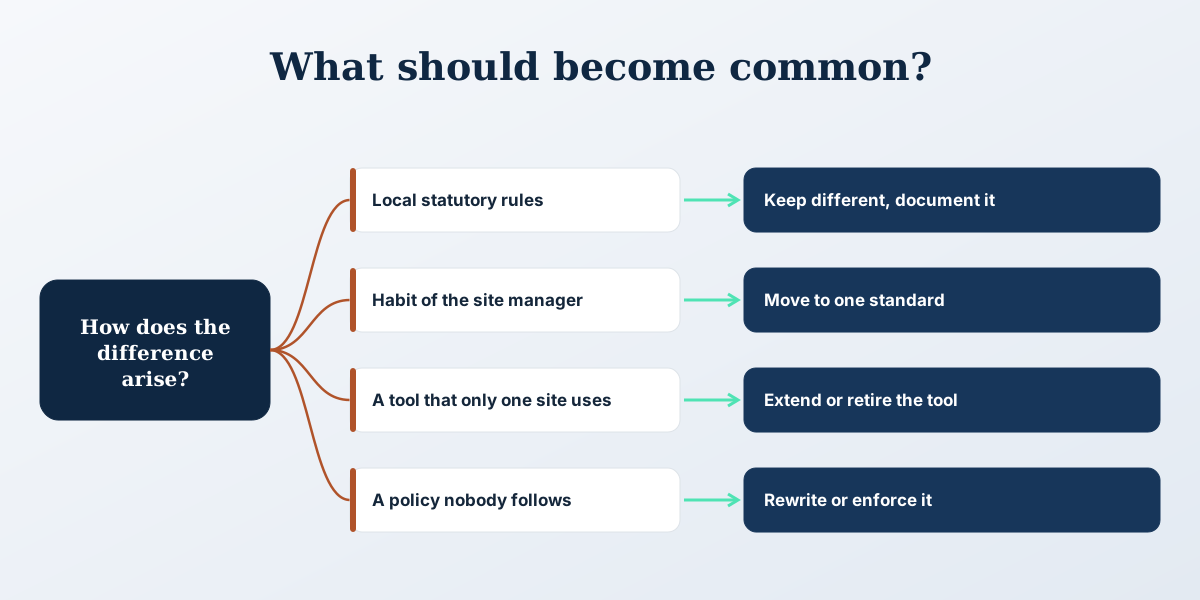
Three views of how this works: the steps, how to choose, and what to aim for.
Why it matters
Multi-location employers rarely have one HR process. They have several, each built by whoever ran the site at the time. The cost shows up as payroll disputes between sites, files that fail an audit in one state and pass in another, and managers who cannot compare people fairly across locations. An audit makes the differences visible. It also separates differences that are justified, such as local statutory rules, from ones that are only habit. That is where a common standard saves effort.
What we need from you
- A list of locations with headcount and employment types
- Policies and process notes used at each location
- A sample of employee files and payroll registers
- Registers and licences held at each site
Not included
- Legal opinions on local law, which come from qualified counsel
- Changes to your organisation structure
- Implementation of a new HRMS, which is a separate service
Multi-location HR Operations Audit FAQs
What is a multi-location HR operations audit?
It is a comparison of how each site runs HR, covering process, records, payroll, policy and statutory position. It ends in a ranked list of gaps and a plan for a common standard.
Do you visit every location?
Not always. HRBS samples documents and holds interviews remotely, and visits chosen sites where a visit adds value. The approach is agreed in the scope.
How is it different from a compliance audit?
A compliance audit tests against the law. This audit compares sites with each other and with your policy, and includes compliance as one area. It looks at consistency and cost as well as risk.
Can it support a move to a shared service centre?
Yes. It shows which processes are already alike across sites and which need work first, which helps decide what to centralise.
Will you recommend one policy for all sites?
Only where the evidence supports it. Local legal differences and plant practices can justify differences, and the report says which are which.
How long does it take?
It depends on the number of locations and how available the documents are. The scope and timeline are agreed in writing after a short call.
What is multi-location HR?
Multi-location HR is the work of running hiring, payroll, compliance and employee records across several plants, offices or states. The main challenge is keeping practice consistent while respecting local rules.
Does the audit cover different states?
Yes. State rules on registrations, wages and holidays differ, so gaps are listed by state and location, with the date each rule was checked.
How often should the audit be repeated?
Once a year suits most groups, and again after opening a site or buying a business. A lighter check on the top gaps after six months shows whether the fixes held.
What the comparison table looks at, area by area
The audit asks the same questions at every site. These are the kinds of differences it tends to expose.
Justified difference or habit?
Not every gap is a problem. Use these tests to sort what you find.
- Is the difference required by a state rule, a union agreement or a statutory licence? Keep it, and document it.
- Does it follow a real operating need, such as shift pattern or contractor mix? Keep it if the need still exists.
- Does anyone know why it started? If nobody does, treat it as habit.
- Does it cost money, delay payroll or create audit risk? Then rank it for fixing, whatever its origin.
How to choose sites for a sample
You rarely need every site in the first round. A fair sample usually includes:
- The largest site by headcount
- The smallest site, where discipline often slips first
- Any site added by acquisition
- A site that recently had an inspection or audit finding
- A site in a different state from head office
Agree the sample in the scope, and say why each site was chosen.
After the report: what a sensible common standard covers first
Start with the processes that cause the most rework or risk. Leave the rest for later rounds.
Questions to put to site managers
Short interviews often explain what the documents cannot.
- What do you do differently from other sites, and why?
- Which HR task takes most of your week?
- What do employees ask you most often?
- Which register or record do you worry about in an inspection?
- What would you want head office to decide once, for everyone?
Who it does not suit
A single-site employer gains little from a comparison, though a records and compliance review may still help. A group that has already chosen to close or sell most sites should wait. And if leadership will not name owners for the gaps, the report will sit unread. Decide who owns follow-up before the audit starts, and see the HR compliance and labour advisory page if compliance is the main worry.
Common questions
How many locations do you need before an audit makes sense?
Two is enough if the sites run HR differently, though the value grows with each added site. A group with three or more plants, branches or offices, or one that has bought another business, usually sees clear differences in payroll, records and approvals from the first sample.
Who should sponsor a multi-location HR audit inside the company?
Ideally someone senior enough to settle disputes between sites, such as the head of HR, the COO or the finance head. Site managers should be consulted, but they should not own the audit, because the findings will sometimes point to their own practice, which makes neutral ownership fairer.
What do we do with the report afterwards?
Pick the top few gaps by risk, name an owner and a date for each, and agree one common standard to roll out first. Review progress every month with the owners. After about six months, run a light check on those gaps to see whether the fixes held.
Can the audit be done if some sites keep paper records?
Yes. Paper files and registers can still be sampled by photograph, scan or a visit. The audit notes where records are paper only, because that affects how quickly you can answer an inspection or an employee query, and it shapes the plan for a common system or a shared service centre.
Talk to HRBS about Multi-location HR Operations Audit
Book a free HR review. It is a short call, and we tell you what to do first.
Book an HR review